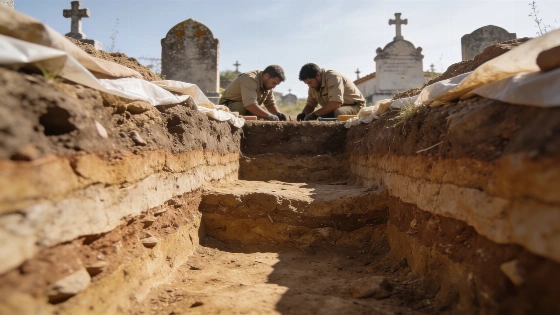
Researchers estimate that between 100 and 150 people were killed in Hornachos in 1936. More than 100 people who were disappeared or subjected to repression are being sought in the town. The cemetery may hold several mass graves: archaeologists have identified at least one and suspect there are three or more.
The latest excavation campaign, led by Fomento de Técnicas Extremeñas (Fotex), began on 13 October 2026 and has uncovered at least 15 bodies so far. The grave was located beneath a monument commemorating Civil War victims. A search at the cemetery in February 2026 produced no recoveries. The bodies lie on top of one another. Ana María Rabazo, co-director of the excavation, said this indicated a mass grave rather than a burial arranged through a formal ritual. The grave’s boundaries and depth had not yet been established, so the final number of people buried there remained unknown.
Clothing from the period and objects found with the remains support the investigation. The team has found shoes and a comb, along with buttons and work boots. Agencia EFE reported that the objects could not identify individual victims. Rabazo said the footwear was inconsistent with relatives burying their dead in the usual way.
No bullets have been found in the grave so far. The researchers believe the executions took place against the cemetery wall, where impact marks remain visible. Rabazo explained that projectiles may be recovered from inside bones, including the femur or skull, during examination of the remains.
Jesús Martín, the other co-director, said studies put the number killed in the municipality at between 100 and 150. His estimate gives the 15 recovered so far a wider context: the cemetery may hold many more victims than this first identified grave.
Among those killed was Miguel Caballero Rosa. He was 33 when he was taken from his home on 2 October 1936; his family never heard from him again. His granddaughter Maribel Caballero visited the excavation site roughly 90 years later, hoping his remains might be found. She described him as an ordinary local vegetable grower who read the newspapers. Her father was three and her uncle five when Miguel was taken, she recalled. Her grandmother was widowed and never saw her husband again. She said the exhumations were about restoring dignity to those buried there.
Only grandchildren and great-grandchildren of the victims are now alive, according to the account. Hornachos mayor Francisco Buenavista said families were seeking justice and dignity, not a reopening of divisions. The town council says it aims to locate the cemetery’s different graves and recover victims for identification and dignified reburial. The municipality plans to build a shared mausoleum for the recovered remains. Families’ calls for recognition have also featured in coverage of the Urda victims’ funeral.
The excavation is funded by a €57,000 grant from the Junta de Extremadura. A further €18,000 from Spain’s Secretaría de Estado de Memoria Democrática is expected to extend the excavation work, bringing planned funding to €75,000. DNA identification is not currently funded. According to EFE, the process could take years.