In April 1986, the International Council on Monuments and Sites (ICOMOS) issued a favourable assessment of Toledo’s historic centre. It recommended inscription under World Heritage criteria (i), (ii), (iii) and (iv), addressing artistic achievement, cultural interchange, historical testimony and urban or architectural significance. That report helped clear the way for the World Heritage Committee to inscribe the city later that year, at its 10th session.
Spain’s Ministry of Culture presented the official candidacy in 1985; UNESCO records the nomination date as 30 December. The nomination preceded ICOMOS’s April 1986 evaluation and the committee’s inscription decision, recorded as “10 COM VIII - Inscription: Historic City of Toledo (Spain).” During the mayoralty of Joaquín Sánchez Garrido, Toledo was entered on the World Heritage List under reference number 379, recognising more than two millennia of continuous history. Official documents of the period called it «la pequeña Florencia de España», citing its concentration of artistic and monumental heritage. ICOMOS described an artistic sequence extending from Visigothic churches to Baroque ensembles of the early 18th century.
The designation also recognised Toledo as a city of three cultures. Its Christian, Jewish and Muslim heritage formed part of that description, while the formal inscription recommendation rested on the four UNESCO criteria. A separate report on Spanish architectural heritage examined Gaudí's estate plans to direct proceeds from his assets towards work on the Sagrada Família.
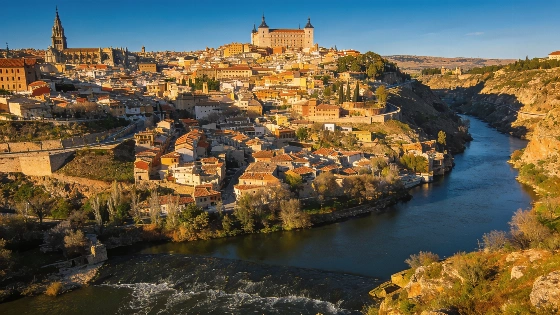
The protected area covers about 260 hectares of the Casco Antiguo, bounded by the river Tajo. UNESCO’s precise property measurement is 259.85 hectares; the associated buffer zone covers 7,669.28 hectares, for a combined total of 7,929.13 hectares. The historic city stands on a steep rocky elevation encircled by the Tagus, about 70 kilometres south of Madrid. In 2013, the World Heritage Committee clarified the property boundaries and areas; UNESCO adopted a retrospective statement of outstanding universal value for Toledo in 2023, and its archive lists periodic reporting for 2024. The 2026 anniversary marks 40 years since inscription.