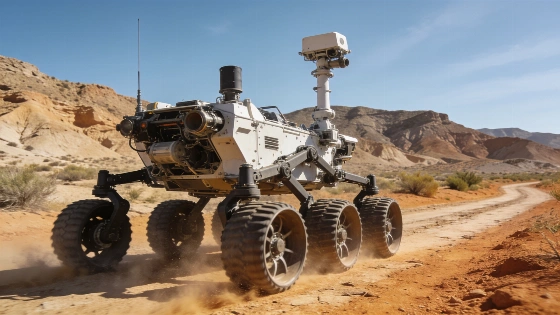
Operations for the six-wheeled Charlie rover were run from Italy during trials in Spain's Tabernas desert. The campaign tests systems planned for ExoMars Rosalind Franklin, including navigation when Earth cannot respond at once.
Operations for the six-wheeled rover were coordinated from Turin, Italy, while Charlie crossed the Tabernas desert in Almería. The setup copied one problem that Rosalind Franklin will face on Mars. Its operators cannot answer every move in real time.
Charlie will stay on Earth. It is a ground-based demonstrator for systems and procedures planned for ExoMars Rosalind Franklin. The test site is built to resemble part of the work ahead, millions of kilometres away.
That delay changes everything.
Almería had already served as an ESA analogue site in 2018, when the agency used the Tabernas area for ExoFiT-related testing of planetary exploration technologies.
Autonomous navigation sits at the centre of the campaign. Charlie moved across Almería while teams worked remotely from Turin instead of standing beside the rover. Communications between Earth and Mars take several minutes, so Rosalind Franklin must handle many decisions on its own.
Its cameras must spot obstacles and build a three-dimensional view of the ground. They also help calculate a safe route. The rover is designed to travel about 100 metres during a Martian sol, with stereoscopic cameras selecting suitable paths.
The Tabernas trials also test how navigation choices fit with scientific work. A route cannot be judged separately from the tasks the rover must complete.
The distance is not a technical footnote. It sets the limits of control from Earth.
ESA, Airbus and other European partners took part in the campaign. Their teams tested the working sequence needed for planetary operations: spotting hazards, choosing routes and carrying out science through procedures tried on Earth.
Charlie is the stand-in.
It lets the teams assess those systems before Rosalind Franklin leaves for Mars. The rover must connect safe movement with scientific operations, even when instructions arrive late.
After cooperation between ESA and Roscosmos ended, European industry had to complete and qualify the lander and related systems on a compressed schedule. The work is intended to preserve the current target of a 2028 launch and a Mars arrival in 2030.
The mission is not limited to examining the surface. According to the current ESA ExoMars factsheet, Rosalind Franklin is targeted for launch in 2028 and arrival at Mars in 2030.
At Oxia Planum, it will search for signs of past or possible present life in clay deposits formed when liquid water existed on Mars. That makes the site a major target for the mission.
The rover's most distinctive tool is a drill that can reach about two metres below the surface. Radiation and chemical processes on Mars can destroy organic molecules close to the ground. Material below the surface may have stayed better protected for billions of years.
The drill will send samples to the rover's internal laboratory. Instruments there will examine whether Mars once had conditions suitable for life and whether traces of those conditions remain in its materials.
Oxia Planum will be studied in several ways. Rosalind Franklin carries terrain cameras, spectrometers for composition, radar for layers below the ground and laboratory instruments for drilled samples.
The clay deposits formed in an environment linked to liquid water. Researchers will use them to look for chemical evidence that may have survived.
Spain's role goes beyond the testing ground. Spanish company Sener designed and manufactured the ExoMars lander's four deployable legs. It also worked on the separation system and components connected to the rover's drill.
Sener has reported progress toward qualifying the landing equipment. European partners are preparing the mission for its revised schedule.
The legs must absorb the forces of landing. Shock absorbers and sensors detect the moment the platform touches down. ESA has tested the systems with a full-scale lander model.
The tests included impacts on hard surfaces and materials prepared to reproduce Martian ground conditions.
Tabernas shows the hardest part of the mission. Mars cannot be driven like a nearby vehicle.
Charlie brings navigation, science and remote operations into one test before launch. The Almería campaign checks whether Rosalind Franklin can move and work safely when Earth is too far away to steer every turn.