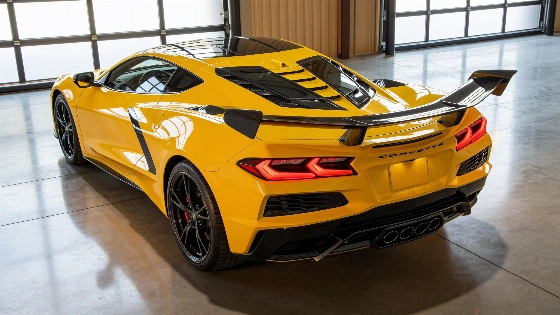
Chevrolet’s new Corvette ZR1 delivers record-breaking performance, but its immense aerodynamic downforce is causing paint to crack at high speeds. Owners are reporting visible damage, prompting General Motors to step in with repairs.
At nearly 300 km/h, the Chevrolet Corvette ZR1’s engineering triumph becomes its own undoing. Owners of the latest ZR1, the most powerful production Corvette ever built, are discovering that the car’s extraordinary aerodynamic downforce—over 544 kilograms at top speed—can physically damage the paintwork around the rear wing supports.
The ZR1’s heart is the new LT7 engine, a 5.5-litre flat-plane crank V8 with twin turbochargers, producing 1,064 horsepower at 7,000 rpm and 1,122 Nm of torque at 6,000 rpm. This marks the first time a production Corvette has left the factory with forced induction, pushing the eighth-generation model into the realm of modern hypercars. Power is sent exclusively to the rear wheels through a reinforced eight-speed dual-clutch automatic transmission, enabling the ZR1 to sprint from 0 to 100 km/h in just 2.4 seconds and reach a top speed of 346 km/h.
Chevrolet offers two aerodynamic setups for the ZR1: a standard low-drag configuration for maximum speed, and the optional ZTK Performance Package, which transforms the car’s handling on track. The ZTK pack adds a massive fixed carbon-fibre rear wing, aggressive front aero elements, canards, a Gurney flap on the bonnet, and bespoke Michelin Pilot Sport Cup 2R tyres. According to General Motors, this setup generates more than 544 kg of downforce at full speed, dramatically improving stability, cornering, and braking.
Paintwork Under Pressure
But this race-inspired downforce comes at a cost. Social media user @Wheelr_ shared a video showing how his white Corvette ZR1 developed paint chips around the carbon-fibre wing mounts after a high-speed session at Daytona, where the car approached 300 km/h. The damage is clearly visible where the wing’s supports meet the bodywork, a result of the flexing forces transmitted through the mounts as the wing is pressed down by the air at speed. The factory paint simply cannot withstand the repeated stress, leading to cracks and chips.
Other owners have reported similar issues. In the same video, @Wheelr_ mentions a friend who experienced identical paint damage after fitting a ZR1 wing to a Corvette Z06 and driving at 295 km/h. This suggests the problem lies not with the paint itself, but with the design and mounting of the rear wing—a flaw that risks spoiling the ownership experience of a car costing $185,000 in the US.
General Motors has acknowledged the issue and committed to repairing affected cars under warranty. For buyers investing in a flagship American supercar, this response is essential. The ZR1’s combination of power and downforce is rare in road-legal vehicles, but it also highlights the challenges of translating race technology to the street.
Chevrolet’s dilemma is not unique. Other high-performance brands have faced similar challenges when pushing the limits of aerodynamics and materials. For example, the Porsche 911 GT3 Touring has been praised for its balance of everyday usability and track capability, but even Porsche has had to address durability concerns in extreme use cases.
As supercars become ever more powerful and aerodynamically advanced, manufacturers are forced to confront the unintended consequences of their own engineering. For Corvette ZR1 owners, the lesson is clear: with great downforce comes unexpected responsibility—and sometimes, a trip back to the body shop.