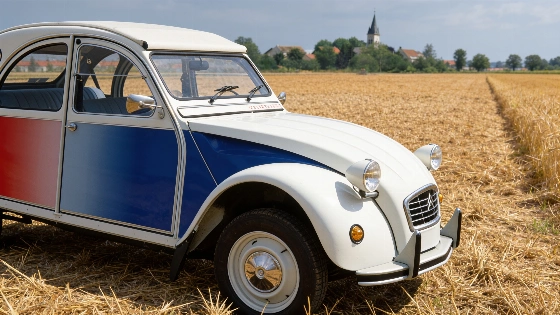
Forty years after its launch for the 1986 World Cup, the Citroën 2CV Cocorico remains one of the brand’s most elusive and patriotic models. Its bold tricolor design and limited run have turned it into a collector’s gem, even as it fades from Spanish roads.
In October 1986, Citroën released a car that captured both national pride and the spirit of a football-crazed summer: the Citroën 2CV Cocorico. Conceived as a tribute to the French national team and the World Cup in Mexico, this limited edition model was produced in just 1,000 units, all destined for the French market. Today, as Citroën marks the 40th anniversary of the Cocorico, the car stands as a rare symbol of a moment when sport, design, and national identity collided.
The Cocorico was the brainchild of designer Serge Gevin, who set out to create a version of the 2CV that would channel the optimism of a possible French victory. The timing was deliberate: France, led by Michel Platini, had just won the 1984 European Championship and entered the 1986 World Cup with high hopes. Their campaign in Mexico was thrilling—eliminating reigning champions Italy and overcoming Brazil in a dramatic quarter-final—before falling to West Germany in the semifinals. Despite the heartbreak, the Cocorico project pressed ahead, shifting from a football-themed celebration to a broader homage to French culture and style.
Visually, the 2CV Cocorico is impossible to mistake. Its body, finished in Blanc Meije, is adorned with sweeping blue, white, and red graphics along the doors—a direct nod to the French flag. The rear fenders are painted in Rojo Vallelunga, while the side panels of the hood feature Azul Cocorico, creating a striking tricolor effect. Red ‘2CV Cocorico’ decals, a white soft top, matching wheels, and stainless steel hubcaps borrowed from the Dyane 6 complete the exterior. Inside, the car keeps things simple but distinctive, with blue sodalite Tep Jean upholstery on the two front seats, evoking a sense of 1980s French casual chic.
Technically, the Cocorico was based on the 2CV 6 Spécial, the entry-level version of the legendary model. It retained the hallmark features that made the 2CV a French icon: a 602cc two-cylinder engine producing 29 DIN horsepower, feather-light construction under 600 kg, and the famously supple suspension. Production ran until March 1987, and while initial sales were modest—perhaps dampened by France’s World Cup exit—the car’s rarity has since made it one of the most sought-after 2CV variants among collectors.
Over time, the Cocorico’s meaning evolved. What began as a football tribute became a rolling celebration of French identity, stripped of overt sports references in favor of timeless national symbolism. Its scarcity and bold design have only increased its allure, especially as the 2CV itself has become a cult object. Citroën’s ability to transform a humble utility car into a canvas for creativity and national pride is echoed in more recent special editions, such as the Ami’s collaboration with Rip Curl, which brought a fresh, youthful twist to the brand’s tradition of limited-run models—see the Ami’s surfer-inspired editions for another example of Citroën’s playful approach to design.
As Citroën prepares to unveil a new electric 2CV prototype at the Paris Motor Show, the Cocorico’s legacy serves as a reminder of how a car can capture the mood of a nation. For Spanish enthusiasts, however, the Cocorico remains a rare sight—its exclusivity and unmistakable tricolor livery ensuring that, even four decades on, it is a piece of French automotive history that is more admired from afar than seen on local roads.
Additional context: The 2CV Cocorico was never officially sold in Spain, contributing to its near-mythical status among collectors outside France. Its launch coincided with France’s National Day, July 14, and the 40th anniversary is marked just as France faces Spain in the 2026 World Cup semifinals in the United States. The 2CV’s enduring popularity has inspired Citroën to revisit its heritage, with the upcoming electric 2CV aiming to blend nostalgia with modern technology.