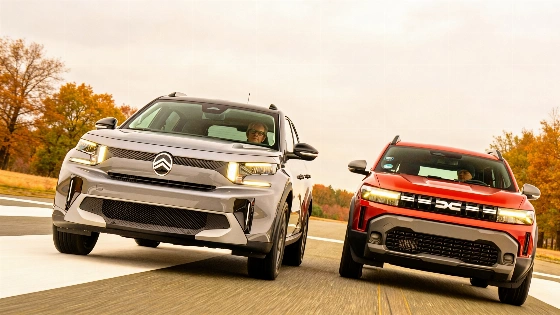
Citroën C3 Aircross Turbo 100 vs Dacia Duster Eco-G 100: the battle of budget SUVs for buyers in Spain. Citroën C3 Aircross Turbo 100 and Dacia Duster Eco-G 100 are two affordable SUVs with petrol engines, competing in the segment up to €20,000. The French and Romanian crossovers offer different approaches to equipment and comfort.
A new round of competition has emerged in the affordable SUV segment in Spain: the Citroën C3 Aircross Turbo 100 and the Dacia Duster Eco-G 100 are entering the market with prices barely exceeding €19,000. Both vehicles are aimed at buyers looking for a practical and budget-friendly crossover, but rely on different technical solutions and approaches to equipment. As noted by Auto Bild, both models offer petrol engines with around 100 hp, but differ in architecture, comfort level, and interior details.
Platform and equipment
The new-generation Citroën C3 Aircross is built on the Smart Car platform, optimized for cost within the Stellantis group. This made it possible to keep the starting price just above €19,000, while the tested Turbo 100 version costs a little more than €20,000. The Dacia Duster Eco-G 100, in turn, positions itself as a direct competitor, offering a similar level of equipment but with a slight price advantage—about €200 cheaper. Importantly, the Duster is also available with a more powerful engine and all-wheel drive, which broadens the options for buyers.
Inside, the Citroën clearly wins in terms of finish quality: the cabin has less hard plastic compared to the Dacia and more attention to detail. However, the Duster compensates for this with practicality—one-touch power windows on all doors and a keyless entry system (though available only in higher trims) make it attractive to those who value functionality.
Interior and space
Both crossovers offer spacious interiors, but the Citroën C3 Aircross stands out with a more modern digital cockpit. Starting from the mid trim level, a 10-inch touchscreen appears on the front panel, while in the base versions of both cars, only a smartphone holder is provided. The Advanced Comfort seats in the Citroën ensure a soft seating position and good leg support, though the Duster seats are equally comfortable. In the second row, the Citroën offers a bit more knee and headroom, although neither car features a rear armrest.
The Citroën C3 Aircross can accommodate seven passengers, but even in its five-seat configuration, its trunk is slightly more spacious: from 460 to 1600 liters versus 453–1545 liters in the Duster. This advantage could be important for families seeking a versatile urban SUV.
Engines and performance
The Dacia Duster Eco-G 100 is equipped with a 1.0-liter three-cylinder turbo engine that can run on both petrol and liquefied petroleum gas (LPG). Maximum output is 101 hp; when running on gas, the engine becomes a bit more responsive, but noticeably rougher in sound. The Citroën C3 Aircross Turbo 100 uses a 1.2-liter three-cylinder turbo engine with similar power, but offers a smoother pull and a more pleasant low-frequency sound. The French crossover has an advantage in torque and its available range, allowing for longer gear ratios and better dynamics: it accelerates from 0 to 100 km/h in 12.1 seconds versus 13.3 for the Duster, with a top speed of 179 km/h (Dacia — 168 km/h).
Ride quality and comfort
At speeds above 100 km/h, the Citroën offers better sound insulation—both in terms of aerodynamics and tire noise. Fuel consumption is similar for both vehicles, but the Duster allows for additional fuel savings when running on gas. In terms of handling, the new generation Dacia Duster has become noticeably stiffer: the steering features good feedback and precision, but the suspension transmits small bumps into the cabin. The Citroën’s steering is light and compact, though on the highway, the electronics artificially increase steering effort to keep the car in lane, which may feel unnatural. At the same time, the Advanced Comfort suspension with unique shock absorbers delivers a high level of comfort without excessive body roll.
Market context
The Citroën C3 Aircross Turbo 100 and Dacia Duster Eco-G 100 are among the few SUVs that will remain in the affordable price segment in Spain in 2026. Both vehicles are aimed at buyers who prioritize practicality, efficiency, and modern features, but they offer a different balance between comfort, functionality, and driving dynamics. Against the backdrop of rising prices and a shrinking selection in the budget segment, such models are becoming especially relevant for the Spanish market. Interestingly, Citroën continues to experiment with affordable formats: the brand recently unveiled the return of the iconic 2CV in an electric version—read more about this in the article about the debut of the new Citroën 2CV at the Paris Motor Show.
Both crossovers remain among the most attractive options for those seeking an affordable yet modern SUV with either a petrol or gas engine. Their success on the market will depend on how willing Spanish buyers are to accept compromises in interior trim for the sake of savings, or whether they prefer a higher level of comfort and equipment.