In Spain's threatened wetlands, amphibious machines and grazing cows are helping restore balance and capture carbon. The LIFE Wetlands4Climate project is testing how these fragile ecosystems can contribute to climate mitigation while supporting biodiversity.
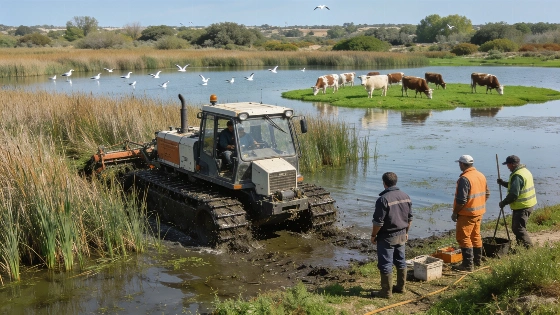
Early morning in Prat de Cabanes-Torreblanca, a massive amphibious machine pushes into the reeds. Birds scatter, and the marsh changes shape. The work is part of an effort to restore Spain's Mediterranean wetlands after years of neglect and turn them into carbon traps.
The LIFE Wetlands4Climate project, run by Fundación Global Nature, is leading the work. Over four years, the team has tested targeted actions, including mowing with amphibious machines and letting cows graze, alongside soil management. The goal is to find out whether these steps can help wetlands absorb more greenhouse gases. Wetlands store huge amounts of carbon, but when they degrade, they can quickly release it back into the air and accelerate climate change. El País reports that excess vegetation and organic matter can reduce oxygen in the water, increasing methane emissions and carbon loss. The project covered ten wetlands across the Iberian Peninsula. The team compared managed and unmanaged plots, tracking vegetation while measuring soil conditions and gas exchanges. Final independent results are still pending.
Carlos Rochera from the Instituto Cavanilles de Biodiversidad y Biología Evolutiva at the Universitat de València puts it bluntly: "A wetland that degrades can lose in a short time a part of the carbon it has collected so slowly, returning it to the atmosphere as greenhouse gases." Centuries of slow carbon savings can vanish in one bad season.
The project's methods break with tradition. Amphibious machines cut through thick carrizo reeds, leaving a patchwork of open water and plants. More birds arrive. The cut reeds are dried and crushed before being reused as bedding or feed. In muddy spots where machines cannot go, local farmers like Miguel Marín use tractors to churn the topsoil. This old method, called fangueo, keeps the marsh open and lively. El País notes that the project removes only excess vegetation. The aim is to maintain a balance of open water and reed beds, while preserving other habitats rather than clearing the vegetation entirely.
The real shift happens underground. The team uses scientific tools to track changes in soil and gas levels. Its data shows that managed plots capture more carbon than untouched ones. The method is awaiting certification from Spain’s Ministry for Ecological Transition. If approved, companies could one day pay for wetland restoration to offset their emissions, as they do with forests. El País reports that official certification is still pending, so claims about carbon capture remain provisional.
Some actions are far from gentle. In Marjal del Moro, a protected wetland between Puzol and Sagunto, bulldozers have scraped off the top ten centimeters of soil in certain areas. This drastic step reduces the buildup of organic matter, which, if left in place, can deplete oxygen and trigger methane emissions, throwing the environment off balance. The removed soil is tested before being reused as fertilizer. Even the toughest interventions are weighed against nature’s needs.
Elsewhere, Fran Panella’s cows do the quiet work. They graze the wide marshes of Pego-Oliva, acting as living mowers that keep plants young and boost CO2 capture. GPS collars keep them in the right spots. When the ground risks becoming too compacted in late September, the cows move to higher ground, also helping prevent wildfires.
Water is always the wild card. In Marjal de Pego-Oliva, natural springs called ullals feed the marsh, but summer brings competition for water from rice fields and holiday homes. Park managers regulate water flows to sustain the environment and soften the impact of extreme weather. El País describes hydrological management, regulating water inflow and outflow, as a distinct part of the climate strategy. It supports the environment and helps mitigate increasingly frequent extreme rainfall events. The marsh becomes a sponge, soaking up floods.
These wetlands have long been shaped by people. Once seen as mosquito-ridden wastelands, they were drained, farmed and nearly lost to industry. In the 1980s, public outcry stopped Marjal del Moro from becoming a steel plant, preserving it for wildlife and climate defense.
The threats remain. Modern industrial parks now press against these fragile areas, diverting water and squeezing the wetlands’ lifelines. Ana Pons, who leads the Centro de Educación Ambiental de la Comunidad Valenciana, says a wetland’s health depends as much on its surroundings as on its core. A new warehouse or canal can tip the scales.
The project has earned recognition: LIFE Wetlands4Climate won the LIFE Award 2026 for Climate Action from the European Commission. The award recognizes its combination of fieldwork and science. The next test is whether these methods can be expanded and funded.
With careful management, including the use of machines and cows, Spain’s wetlands are being reshaped as living landscapes for nature and people. Restored wetlands capture carbon and build ability to recover, giving these critical places a role in Spain’s climate response.