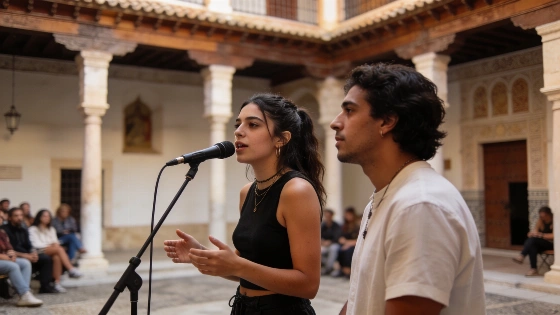
CULTUR.ALH has opened in Granada with a tribute to Gata Cattana. More than 60 authors and 30 free events will fill the city from 21 to 27 September.
Granada has opened a week of artistic experimentation with a tribute to Gata Cattana at La Madraza. The event began the second edition of CULTUR.ALH, the Festival Internacional de Arte, Literatura y Humanidades de la Universidad de Granada. Music and poetry sit at the centre of the programme.
More than 60 writers, artists, philosophers, musicians and historians will take part in more than 30 free activities from 21 to 27 September. According to the University of Granada, the programme is spread across 13 venues in the city centre.
The opening was not a conventional literary ceremony. Its official title was 'Mi libertad no cabe ni en jaulas de plata blanca'. Carmen Xía led a 'listening party', followed by a 'reading party' devoted to the work of the Córdoba poet and rapper. Víctor Simón joined the programme as a poet, rapper and researcher of the links between poetry, Spanish rap and contemporary urban music.
CULTUR.ALH’s second edition runs from 21 to 27 September 2026 and uses 13 venues in central Granada for more than 30 free events.
Gata Cattana gives the festival a clear starting point. She was a recent Granada-linked avant-garde figure whose work joined artistic expression with political and literary thought.
Before the music and spoken performances, cultural researcher and communicator Fran Checa gave the talk '10.000 oyentes bien usados son un ejército'. He examined the aesthetic, political and literary force of the writing of the Córdoba artist and political scientist, who died in 2017.
CULTUR.ALH is built around an idea rather than one artistic discipline. Its motto is "La vanguardia que fue, la vanguardia que será". The programme links the current festival to Granada's tradition of renewal associated with Federico García Lorca, Manuel de Falla, José Val del Omar and José Guerrero.
The University of Granada presents the festival as part of its V Centenario. It has support from the Ayuntamiento de Granada, the Granada 2031 European Capital of Culture candidacy, Acción Cultural Española and the Instituto Cervantes.
The international profile of the programme extends beyond the opening tribute. Independent coverage lists John Banville, Juan Villoro, Patrick Boucheron, Silvia Federici, Gabriela Cabezón Cámara and Rita Segato among the participants, placing the Granada event within a wider Spanish-language and international cultural network.
That approach will spread across the city through group readings, unusual meetings with authors and direct exchanges between artistic fields. The organisers call Granada a "laboratorio de vanguardia contemporánea". The city itself is part of the setting, rather than the festival being confined to one auditorium or cultural circuit.
Participation also sets the event apart from the accountability dispute described in an earlier report about Valencia's dana. The stated aim here is cultural: to bring literary and artistic work into public space and let different forms of creation meet within one programme.
The launch has also come during a separate public dispute over the withdrawal of Argentine writer Ariana Harwicz from the programme. The University of Granada said the festival's direction made the decision, not the rectorate. It also said the decision was not an assessment of Harwicz's work.
El País and ABC reported that the dispute formed part of the public context around the start of CULTUR.ALH. Infobae reported on 21 September that the Argentine Embassy had requested an official explanation and redress.
Ana Gallego Cuiñas, a professor at the University of Granada, directs the festival alongside editor Patricia Escalona Ruiz. She has described the goal in direct terms. The organisers are not mainly seeking full auditoriums. They want more readers across the city.
That is the strongest idea in CULTUR.ALH. Its value will not be measured only by the number of guests or events. The real test is whether the programme makes Granada a meeting place for literature, music, history and philosophy.
Opening with Gata Cattana gives that aim a contemporary voice and a clear artistic reference. The free programme also removes the main barrier between the festival and the public. CULTUR.ALH is testing whether a city can become the active setting for avant-garde work.