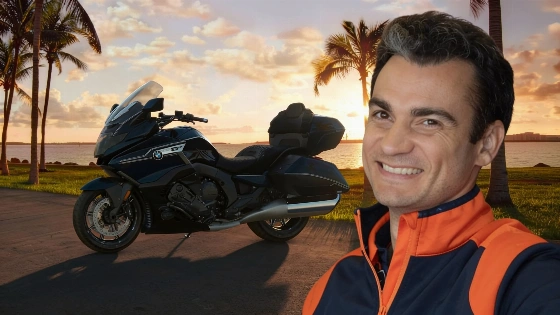
During a recent broadcast, Dani Pedrosa, the three-time Grand Prix world champion and KTM test rider, discussed the appeal of Bagger motorcycles, oversized touring machines known for their imposing presence and American roots. The MotoGP rider, whose compact frame became a talking point throughout his racing career, joked about the mismatch: “You wouldn’t even see me on it. This bike rides without a rider.” Pedrosa’s experience spans championship racing in the 125cc and 250cc classes, as well as MotoGP, giving him a distinctive vantage point on the contrast between purpose-built prototypes and touring-derived machines.
Baggers, with their low-slung silhouettes and integrated hard cases, have long stood apart in the world of grand touring motorcycles. Unlike traditional touring bikes, they typically omit the rear trunk and instead feature wide front fairings and side cases, pairing a distinctive profile with long-distance comfort. Their defining trait is their touring-bike scale: large frames and high-displacement engines, surrounded by large bodywork, stand in sharp contrast to MotoGP prototypes engineered for low mass and aerodynamic efficiency, with cornering performance central to their design.
For a rider used to piloting 150-kilo machines at over 300 km/h, the philosophy behind a Bagger is almost alien. Pedrosa’s career was shaped by the need to extract performance from meticulously engineered bikes, where weight and ergonomics are basic to the design. Standing next to a Bagger, he pointed out that its handlebars and front end would completely obscure him, creating the almost comic impression of a “ghost rider” at the controls.
That contrast is also the premise of King of the Baggers, a category in the MotoAmerica racing program built around taking large American touring motorcycles, particularly Harley-Davidson and Indian models, and preparing them for closed-circuit competition while retaining their recognizable bagger identity. Race versions can undergo large changes: teams revise suspension and brakes, while also adjusting tires, engine tuning and riding position. The aim is not to turn them into lightweight prototypes, but to test the limits of touring-derived motorcycles on a race track. Their mass and dimensions remain part of the challenge, even as race preparation changes how they perform.
The roughly 300-kilo figures often associated with these machines convey the scale of the challenge, although individual weights vary with the model and its race preparation. The physical demands differ from those of a MotoGP bike: mass and center of gravity, along with use at the handlebars, shape how a bagger changes direction and behaves under braking. For a rider accustomed to a compact prototype, the different balance and riding position make the experience fundamentally distinct.
King of the Baggers has become an established part of American motorcycle racing rather than a one-off exhibition. The category’s appeal lies in the change itself: machines associated with relaxed highway travel are adapted for competition without losing the visual identity that defines a bagger. Harley-Davidson’s factory involvement in MotoAmerica King of the Baggers was scheduled to conclude after the 2026 season, while a separate Bagger World Cup initiative was described as expanding, a shift in racing strategy rather than the disappearance of the category.
Pedrosa’s perspective helps make those contrasts accessible to fans. His humor about becoming invisible behind a Bagger’s bulk sits alongside a practical point about how differently the motorcycles are designed and ridden. On a MotoGP bike, low mass and precise responses are basic; on a touring-derived racer, the larger chassis and bodywork make weight distribution and use especially conspicuous.
While Baggers are a world away from the hybrid compacts compared in recent automotive matchups, their presence in both leisure riding and competition reflects the variety of identities motorcycles can embody. For Pedrosa, the Bagger is less about matching prototype-bike speed than about its scale and presence, a machine that, in his words, almost rides itself.
Baggers grew out of an American motorcycle culture that prizes customization and long-haul comfort. Their development into race bikes brings that touring heritage onto closed circuits, where teams test suspension and braking under very different conditions, while also working on engine setup. Pedrosa’s reaction captures the divide between pure speed and touring-bike presence, along with the surprise that can come when a familiar machine is pushed into an unfamiliar role.