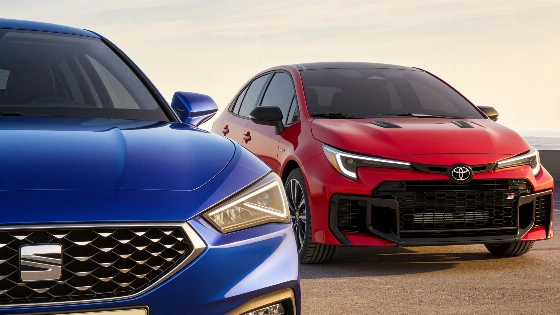
Toyota Corolla and Seat León eTSI stand out among Spain’s compact hybrids, each offering a distinct approach to efficiency and everyday practicality. We compare their strengths, weaknesses, and what sets them apart for city and highway use.
Toyota Corolla and Seat León eTSI have become benchmarks for Spanish drivers seeking compact cars with ECO labels and hybrid technology. While the Corolla leads sales with 15,357 units so far this year, the León eTSI remains a strong contender, delivering 9,039 units between January and July, according to data from Autobild.
Both models target drivers who want a versatile car for city commutes and longer journeys, but their approaches to hybridization differ. The Toyota Corolla relies on a full self-charging hybrid system, while the Seat León eTSI uses a mild hybrid setup, each with its own advantages.
Design and Interior
The Toyota Corolla measures 4.37 meters in length, 1.79 meters in width, and 1.46 meters in height, with a wheelbase of 2.64 meters. Its starting price is €26,750. The interior is straightforward, featuring a 10.5-inch touchscreen and a digital instrument cluster, but it lacks the high-tech feel of newer rivals. Rear seat space and boot capacity (361 liters, expandable to 1,052 liters) are modest, though the León’s boot is only slightly larger.
The Seat León matches the Corolla in length but is marginally wider and lower, with a wheelbase of 2.68 meters. The eTSI version starts at €25,490. Its cabin is more ergonomic, offering a 10.25-inch digital display and a multimedia screen that can reach 12.9 inches in higher trims. The León’s interior feels more spacious, especially in the back, and its 380-liter boot edges out the Corolla’s.
Hybrid Technology Compared
Toyota offers the Corolla exclusively with hybrid powertrains. The entry-level 140H pairs a 1.8-liter petrol engine with an electric motor for a combined 140 hp, available only with the Active trim. The 200H version uses a 2.0-liter petrol engine and delivers 196 hp, both mated to a CVT automatic gearbox. Standard equipment includes 16-inch alloy wheels, keyless entry, LED headlights, and Toyota Safety Sense with over-the-air updates.
The Seat León eTSI, meanwhile, features a 1.5-liter four-cylinder mild hybrid engine with 48-volt technology and a small battery. It comes in two power outputs: 115 hp and 150 hp, both paired with a seven-speed DSG automatic transmission. The León’s range of trims is broader, from Style to FR Special Edition, and even the base model includes 16-inch alloys, automatic climate control, LED headlights, parking assist, cruise control, and multiple airbags.
Driving Experience and Value
On the road, the Corolla’s full hybrid system excels in urban environments, offering smooth, efficient driving and low fuel consumption. However, its CVT gearbox can feel less responsive on highways. The León eTSI, with its dual-clutch DSG, provides a more engaging drive, especially at higher speeds, and its chassis tuning favors stability and comfort.
Price-wise, the Corolla is about €1,200 more expensive at entry level, but the León’s 150 hp version climbs to €31,330 due to its higher trim pairing. For city-focused drivers, the Corolla’s hybrid efficiency is hard to beat. Those who prioritize dynamic handling and frequent highway use may prefer the León eTSI.
Context and Alternatives
Despite the rise of SUVs, compact hatchbacks like these remain popular for their balance of size, efficiency, and practicality. The Corolla’s dominance in Spain reflects a broader trend toward hybrids, while the León’s versatility and value keep it competitive. For those interested in how other brands are challenging the hybrid and electric market, the recent return of the Mitsubishi Pajero, as covered in this analysis, highlights the ongoing evolution of eco-friendly vehicles in Europe.
In summary, both the Toyota Corolla and Seat León eTSI offer compelling options for Spanish drivers seeking an efficient, practical, and eco-labeled compact. The choice ultimately depends on driving habits, budget, and personal preference for technology or driving dynamics.