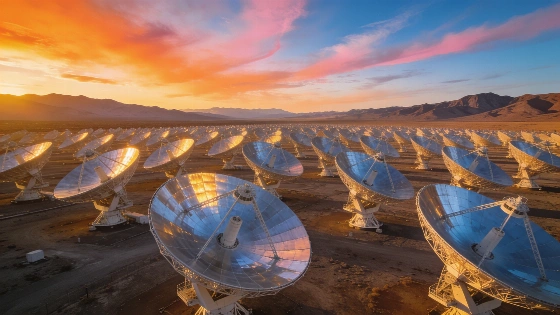
The Deep Synoptic Array, led by Caltech, will soon rise in a remote Nevada valley. With 1,650 antennas and real-time imaging, it promises to transform radio astronomy and open new windows on black holes, pulsars, and the mysteries of the cosmos.
Construction is about to begin on the Deep Synoptic Array (DSA), a groundbreaking radio telescope that will soon dominate a remote valley in Nevada. Designed by the California Institute of Technology (Caltech), the DSA will feature 1,650 parabolic antennas, each 6.15 meters in diameter, spread across an area roughly 20 by 16 kilometers. The project, which has just cleared its final design review and secured funding from Schmidt Sciences, is scheduled for completion in 2029, with scientific operations to follow soon after.
Unlike any radio observatory before it, the DSA is engineered to scan the sky one hundred times faster than current facilities. Its location in Nevada was chosen specifically for its low levels of radio interference, ensuring the clearest possible signals from the depths of space. Although the project is managed from California, the antennas will be installed far from urban centers to maximize sensitivity.
Unprecedented Speed and Sensitivity
Caltech describes the DSA as the most sensitive radio telescope ever built. Its vast network of antennas will allow astronomers to map the sky with a speed and precision previously out of reach. In its first five years, the DSA is expected to survey the entire visible sky multiple times, matching in a single day the roughly 20 million radio sources identified by all other radio telescopes to date. By the end of its initial survey, it could uncover more than a billion new sources.
Vikram Ravi, professor of astronomy and co-lead of the project, notes that "radio astronomy is about to move from sketch to photograph." The DSA will observe a much larger volume of the universe, capturing phenomena at a frequency and scale never before possible.
Real-Time Imaging and Data Innovation
At the heart of the DSA's technological leap is its advanced "radio camera." Signals collected by the 1,650 antennas will be transmitted to a supercomputer equipped with Nvidia graphics processing units, which will convert the raw data into images almost instantly. The volume of unprocessed information will rival the total current internet traffic in the United States. Without this system, storing the data would require around 100 exabytes—equivalent to 100,000 million gigabytes and nearly five million hard drives. Thanks to the radio camera, the annual archive will be reduced to just a few dozen petabytes.
All images will be made freely available to both astronomers and the public, with no exclusivity period. In addition, a system called Chronoscope will analyze the sky at 1,000 frames per second, enabling the detection of rapid, elusive cosmic events.
Unlocking Cosmic Mysteries
The DSA is set to revolutionize the study of stars, galaxies, supernovae, black holes, and pulsars. One of its key missions will be to investigate fast radio bursts—intense flashes of radio energy from distant parts of the universe that remain poorly understood. Project leaders estimate the DSA could identify over 100,000 fast radio bursts and discover around 22,000 new pulsars during its initial operations. Its observations will also provide new insights into dark matter, gravity, the expansion of the universe, and collisions between neutron stars.
By making its data instantly accessible and dramatically increasing the speed and depth of sky surveys, the Deep Synoptic Array is poised to reshape the field of radio astronomy. As the project moves forward, it promises to deliver discoveries that could redefine our understanding of the universe.