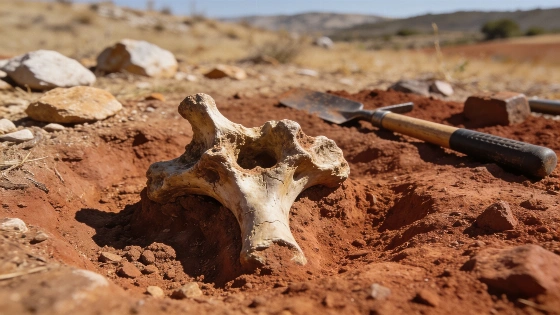
Paleontologists in Teruel have uncovered what may be the first Diplodocus remains found outside North America. Fourteen tail vertebrae and chevrons were identified at La Tejería, a find that could reshape views on dinosaur distribution.
Paleontologists have identified what appear to be Diplodocus bones in Teruel, far from the dinosaur's usual North American range. The fossils, found at the La Tejería site in El Castellar, could change how scientists understand dinosaur migration and distribution during the Jurassic period.
The team from Fundación Conjunto Paleontológico de Teruel-Dinópolis uncovered fourteen well-preserved tail vertebrae and several chevrons from a large sauropod. After detailed comparisons and phylogenetic analysis, published in the Journal of Vertebrate Paleontology, the researchers placed these remains within the Diplodocus genus—a group previously thought to be exclusive to North America. According to Phys.org and Spanish science outlets, this is considered the first confirmed Diplodocus specimen found outside North America, directly challenging the long-standing belief that the genus was limited to that continent.
Independent reports estimate that the animal could have reached about 25 meters in length, highlighting the impressive scale of this Jurassic giant.
The specimen is estimated to be around 150 million years old, dating to the Upper Jurassic. If confirmed, it would be the first intercontinental evidence of Diplodocus, suggesting these dinosaurs may have crossed land bridges or shallow seas that once connected Europe and North America. The find points to a time when animal exchange between continents was possible, challenging the idea that Diplodocus never left North America. Geological layers at La Tejería are reliably dated to the Late Jurassic, providing a solid context for the discovery, as noted by ARA and La Voz de Galicia.
La Tejería has long been a reference point for paleontological research in Teruel, but this find puts it at the center of a new scientific debate. The remains were uncovered by a team led by Sergio Sánchez-Fenollosa, whose work has brought new attention to the region’s fossil record. The study not only documents the bones but also highlights the presence of shared species between Europe and North America during the Jurassic, a detail that could affect how scientists view prehistoric ecosystems. The anatomical features of the vertebrae and chevrons closely match those of Diplodocus, and some independent summaries note a particular similarity to D. hallorum.
The identification still needs further confirmation, but the evidence is strong. The vertebrae’s shape matches Diplodocus, and the context of the find supports the idea of ancient links between continents. Discoveries like this are rare and often lead to a rethinking of established theories, especially when they come from unexpected places.
Some Spanish reports emphasize that the fossil material is fragmentary, so the genus-level attribution, while scientifically significant, still requires further verification. Nevertheless, the discovery strengthens La Tejería's reputation as a key site for studying large Jurassic sauropods in Europe.
Spain’s role in paleontology has grown in recent decades, with Teruel’s fossil beds producing several important finds. The region’s geological history, shaped by shifting continents and changing sea levels, makes such a migration event possible. If the Diplodocus identification is confirmed, it would raise the scientific profile of Teruel and prompt a new look at how dinosaur populations spread and evolved across ancient Earth.
What stands out in this case is the quality of the physical evidence and the careful approach of the research team. The discovery at La Tejería is more than a local curiosity—it directly challenges the established story of dinosaur biogeography. As the scientific community reviews the findings, one thing is clear: the boundaries of paleontological knowledge are less fixed than once thought, and Spain’s fossil record may still hold surprises that could change our understanding of the prehistoric world.