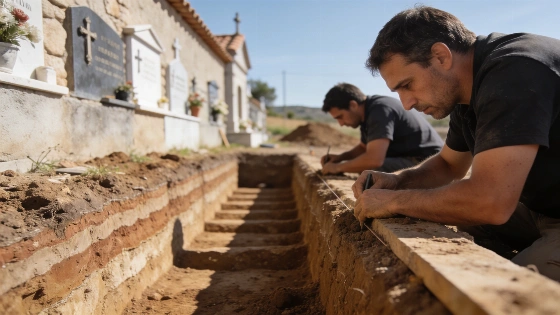
The grave lay about a metre below ground beside the rear wall of Villabermudo cemetery, in Villabermudo de Ojeda, a locality in the municipality of Herrera de Pisuerga, Palencia. Archaeologists recovered six sets of remains there, believed to belong to men from Alar del Rey who were shot during the Civil War.
Oral testimony and bibliographical references point to the six men. According to the account of the exhumation, local residents buried them on the executioners’ orders. A test trench in September uncovered the grave and three bodies; a larger team of archaeologists and volunteers later found three more. The full excavation ran from 29 October to 5 November, seven days of fieldwork.
The remains were kept separate, documented and labelled before being placed in individual boxes for transport to Aditu Arkeología’s laboratory in Ubide, Bizkaia. Preliminary assessments indicate that all six were male. One may have been a minor; the others are estimated to have been between 25 and 50 years old. Anthropologists will assess details such as the victims’ height and age, and look for evidence of how they died.
Francisco Valle, co-director of the excavation, said the study will distinguish fractures sustained before death from those around the time of death. The latter may indicate what happened to the victims. Fractures that occurred after death may have resulted from the weight of accumulated soil, he said. An initial assessment suggests gunshot injuries. Fractures to several skulls are consistent with that possibility, but this is not yet a final finding.
Separate samples will go to a specialist laboratory for DNA analysis, where they will be compared with samples from possible relatives. Valle said the process would take months and would not exceed a year. The results may establish whether one of the six is Manuel Martínez, whose granddaughter Montse Martínez asked the Coordinadora de Memoria Histórica de Burgos to search for him. Oral testimony and bibliographical references underpin the historical attribution of the remains; anthropological and genetic analysis are still to come.
Montse says her grandmother told her that Manuel was taken on the night of 3 August 1936. She searched for him until her death in 1983. In 1982, she had still been unable to obtain his death certificate. Montse hopes the identification will fulfil her grandmother’s wish to find her husband.
The family’s search is one account of how the Civil War’s victims are remembered. The Church’s beatification of Luis Mosquera, executed in 1936, is another. After laboratory analysis, the remains are expected to be returned to the Coordinadora de Memoria Histórica de Burgos and, if identities are established, transferred to relatives. The Villabermudo identification awaits the anthropological and DNA results.