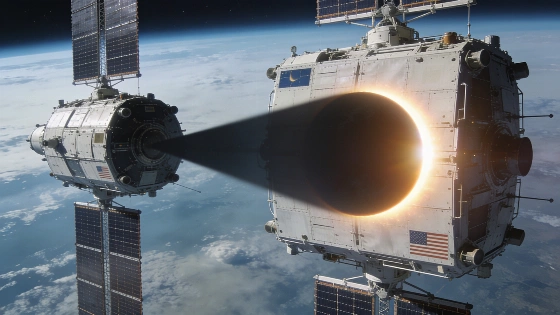
Europe’s Proba-3 mission has achieved a breakthrough: creating artificial solar eclipses in space that last up to six hours. This technology allows researchers to observe the Sun’s corona in unprecedented detail, bypassing the limitations of natural eclipses.
Europe has reached a new milestone in solar observation: the European Space Agency’s Proba-3 mission now creates artificial solar eclipses from space, enabling scientists to study the Sun’s corona for hours at a time. On August 10, 2026, ESA confirmed that Proba-3 had completed its 62nd artificial eclipse, marking a significant advance in solar research.
The Proba-3 system consists of two satellites flying in precise formation about 150 meters apart. One satellite, Occulter, carries a 1.4-meter disk that blocks the Sun’s direct light, casting a narrow shadow onto the second satellite, Coronagraph. Within this shadow, the ASPIICS instrument captures high-resolution images of the Sun’s corona—something previously only possible during brief natural eclipses.
Precision in Orbit
Maintaining this artificial eclipse requires extraordinary accuracy. The two satellites must keep their relative positions within a millimeter, using a combination of star trackers, GPS, radio links, LED-tracking cameras, and specialized sensors. A laser system on Occulter bounces off a reflector on Coronagraph, ensuring millimeter-level alignment. This precision allows the telescope to remain in the eight-centimeter-wide shadow, preventing stray sunlight from overwhelming the faint corona.
Hours of Continuous Observation
Unlike natural eclipses, which last only minutes, Proba-3 can sustain its artificial eclipse for up to six hours per orbit. Each orbit lasts nearly 20 hours, with the formation maintained at over 60,000 kilometers above Earth to minimize disturbances and fuel consumption. By April 2026, Proba-3 had logged more than 250 hours of continuous high-resolution video of the solar corona—equivalent to thousands of ground-based eclipse campaigns.
This extended observation time has already yielded new insights. Researchers have tracked slow solar wind structures moving at speeds between 250 and 500 kilometers per second, challenging previous models that estimated much lower velocities. The ability to monitor the corona for hours is crucial for understanding solar phenomena like coronal mass ejections, which can disrupt satellites, communications, and power grids on Earth.
Spain’s Leading Role
Proba-3 is funded with a budget of €200 million under ESA’s GSTP program. Spain is the largest contributor, providing 38% of the funding, followed by Belgium at 34%. Spanish companies such as Sener Aerospace, Redwire Space, Airbus Defence and Space, and GMV play key roles in the mission’s systems and formation-flying technologies. This project highlights Spain’s growing influence in the European space industry.
The mission’s technological achievements extend beyond solar science. Proba-3 demonstrates that multiple spacecraft can operate as a single instrument with millimeter precision for hours, opening new possibilities for future space missions that require distributed scientific payloads.
As ESA continues to refine this technology, artificial eclipses may become a standard tool for solar research, offering scientists a flexible and powerful way to study the Sun’s most elusive regions—no longer limited by the rare alignment of the Moon and Sun.