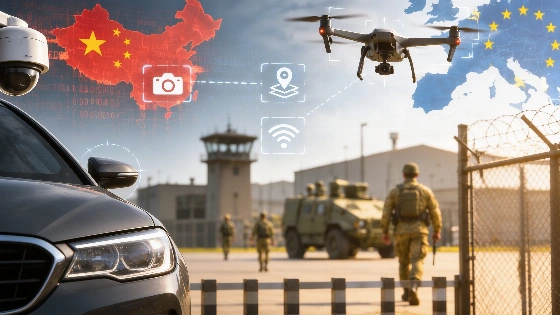
On 10 November 2026, Germany’s defence ministry confirmed that the Bundeswehr would stop using Chinese-made commercially available drones, including systems previously used for target practice and training. The decision followed a risk assessment involving Germany’s Military Counterintelligence Service. The Bundeswehr will replace the models progressively with German or other European products, Reuters reported, citing concerns about military operations and the security of information and data.
The affected equipment must be dismantled. Germany has also restricted Chinese-made vehicles at military sites: service personnel with cars from BYD or Geely must leave them outside and enter on foot. NIO models are covered too. The defence ministry has said there is no blanket ban on vehicles or systems from particular countries; access decisions depend on assessments of individual equipment and sites.
German authorities argue that modern cars and drones can keep sensors active and map their surroundings. Cameras and microphones can record activity around sensitive facilities. Connectivity systems can also collect positioning data and telemetry. Mobile phones, by contrast, can be switched off and handled under security protocols. The concern is what connected equipment might capture around sensitive sites.
Germany's procurement history helps explain the exposure. At the end of 2024, authorities established framework agreements to buy thousands of small commercial drones during 2025 and 2026. The source says urgency over operational gaps led authorities to relax some security checks. Chinese drones had also been used because they were a cost-effective option for training and target practice; the ministry’s current policy is to replace them, not retain them for training.
Norway has documented a more concrete incident. During the Home Guard exercise in Oslo from 14 to 18 September 2026, involving approximately 5,000 soldiers, at least two Chinese-made rental cars recorded personnel and their movements, and stored access codes for restricted facilities. The cars came through Hertz Norway, whose fleet included Deepal models associated with Changan Automobile and equipped with 360-degree cameras and telemetry systems. Reported data included pickup and drop-off locations, routes and time spent at specific places. The cars also recorded codes entered to open gates and doors.
It is unknown whether the recordings stayed in the vehicles or were sent to external servers. There is no public evidence that the manufacturer or an entity linked to China accessed them; the cars' origin alone does not prove that information reached Beijing. Norwegian personnel continued using the vehicles after the recordings were detected because alternatives were unavailable during the exercise. The recordings were deleted after the exercise ended.
Poland banned Chinese-made vehicles from protected military facilities in February 2026 and barred official phones from connecting to their multimedia systems. Its rules also condition entry for vehicles capable of recording on those functions being disabled or facility safeguards being applied. This applies to vehicles that can capture images, sound or location data. The government is studying a certification system for manufacturers and possible exceptions.
The UK has also restricted Chinese cars at sensitive military sites over concerns that connected vehicles could capture and transmit information from their surroundings. Spain's security review has focused on a possible SAIC Motor factory near the Arsenal de Ferrol. The CNI and military intelligence have assessed the risks if the plant opens beside the naval base.
The site is also close to Navantia's shipyards, where vessels for Spain's armed forces are built. The growth of Chinese-backed marques in Spain is a separate commercial story, covered in an earlier sales report on Ebro.