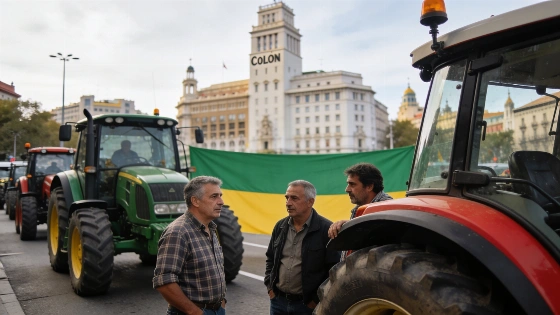
About 700 farmers from nearly every EU member state marched through Brussels’ European Quarter in a symbolic protest against proposed cuts to the Common Agricultural Policy, or CAP. Copa and Cogeca joined the Fédération Wallonne de l’Agriculture (FWA) in organising the march, which ended on Rue de la Loi outside the European Council’s headquarters. Copa-Cogeca announced the mobilisation on 21 November, as EU leaders prepared to discuss the 2028 to 2034 long-term budget. It said farmers and agricultural cooperatives would continue protesting in the weeks ahead.
The organisers are now planning a much larger demonstration for 17 December, alongside a European summit where leaders will seek agreement on the EU budget for 2028 to 2034. The planned route runs from the Atomium to the heart of the European Quarter, according to José María Castilla, director general of Asaja. Brussels hosted a major agricultural protest on 18 December 2025, when around 10,000 farmers and more than 900 tractors converged on the city.
Castilla said more than 10,000 farmers from EU member states had confirmed they would travel to Brussels, bringing about 2,000 tractors. The protest targets a proposed 15% cut to CAP funding in nominal terms compared with the current period. Copa-Cogeca estimates that inflation would lift the effective reduction to 25%; other reporting has put the real-terms cut at more than 20%.
Asaja argues that lower farm support could affect consumers through higher grocery costs. The latest budget proposal from the European Council president includes changes, including a 10% allocation for rural funds, but the association says further revisions are needed. The proposal covers the seven-year 2028 to 2034 financial framework and remains a negotiating position, not an adopted budget. The European Parliament has threatened to veto it. The CAP allocation remains subject to negotiations among EU institutions and member states.
The Union of Small Farmers and Ranchers (UPA) wants CAP funding to remain at least at its current level, with support distributed more fairly. Its secretary general, Cristóbal Cano, says the rules for distributing the budget matter as much as its overall size. UPA wants a maximum cap on payments and a gradual reduction in support. It also seeks a redistributive payment weighted toward small and medium-sized farms, particularly those run by professional family farmers. UPA Aragón, which joined the 26 November Brussels mobilisation, estimated that the proposed changes could remove or redirect more than €700 million from the region’s countryside over 2028 to 2034. Its representatives also met Spain’s Permanent Representation to the EU and European Commission agriculture officials.
Cano said he was not optimistic about the budget negotiations and urged organisations to work to change the latest proposal. He welcomed the European Commission’s indication that 10% of rural development funds would go to the CAP, but said the commitment needed to be put in writing. Agricultural waste has also featured in circular-economy discussions, including a Gran Canaria event.
Luis Cortés, national coordinator of Unión de Uniones de Agricultores y Ganaderos, warned that the latest budget proposal could lead to farms disappearing across the EU. He also pointed to high production costs linked to the war in the Middle East. EU support, he said, was needed to help farmers maintain their incomes.