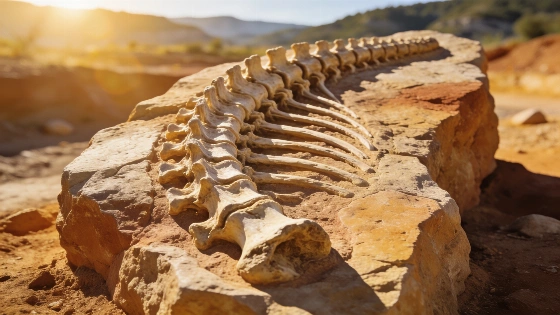
Excavated on 23 November 2026 at the Molí del Piteu site near Isona, in Pallars Jussà, Lleida, the fossil block weighed 18 tonnes and contained about seven cubic metres of rock. It measured up to seven metres long and two metres wide. The team’s first titanosaur neck recovered in the area, at nearby Orcau in 2014, weighed five tonnes and was identified as belonging to the abditosaurio. Researchers regarded that specimen as the largest dinosaur neck excavated in Europe. The new find could belong to an animal larger than the abditosaurio, though its size and species have yet to be established.
The remains include part of the pectoral region and the forelimbs. Unlike the Orcau specimen, they also include some cranial material. The vertebrae may still be connected in their original anatomical position. Preparadora paleontológica Elena Nieto said that would suggest water or other natural forces did not significantly move the carcass after the animal died.
Agència Catalana de Notícies (ACN) reported that Àngel Galobart, director of the Museo de la Conca Dellà and a researcher at the Institut Català de Paleontologia Miquel Crusafont (ICP), said the bones point to a titanosaur from about 70 million years ago. Researchers found the site around five years before the report, and excavation began two years after its discovery. The Molí del Piteu find is the team’s second titanosaur neck recovered in the area, following the Orcau excavation.
Rib measurements offer one reason to consider a greater size: Nieto said the Isona animal’s ribs are longer than those of the abditosaurio, which reached an estimated 15 to 18 metres from head to tail. Researchers have not confirmed that the new neck is the largest found so far. ACN reported that the fossil could represent a different titanosaur species, but its taxonomic identification remains pending. Researchers will prepare and examine the remains before determining their size and whether they represent a species distinct from the abditosaurio.
The team protected the bones with acrylic resin and enclosed them in an iron and polyurethane frame, a fieldwork casing colloquially known as a “mummy”. A fragment from the front section broke away during loading, but the rest of the block remained intact. The effect on the bones still needs assessment.
Many teeth from carnivorous dinosaurs were also found at the site, suggesting the titanosaur may have been preyed upon. The Conca Dellà record includes herbivores of different sizes, from animals around 12 metres long to the 15-to-18-metre abditosaurio. Separate research into prehistoric animal materials includes the Granada cave hide study, which identified goat DNA in fragments dated to about 7,200 years ago.
Preparing the Orcau neck took about six years. Researchers determined that it belonged to a new species a decade after its extraction.