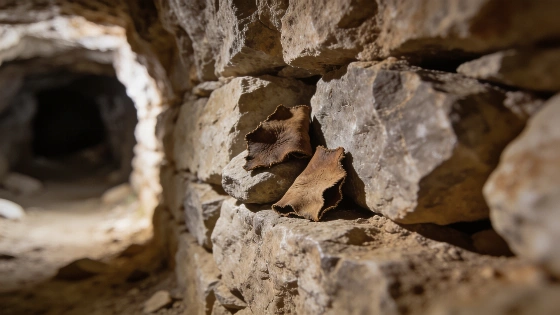
A wall built by miners in the 19th century concealed two scraps of worked animal hide inside the Cueva de los Murciélagos, south of Granada. Radiocarbon dating puts them in the Early Neolithic, at about 7,200 years old, making them a possible candidate for the oldest known leather. Leather and other organic materials rarely survive in archaeological settings, but the cave’s exceptional preservation conditions kept biological material intact enough for genetic analysis.
The fragments were analysed in a study published in PLOS ONE on 4 November 2026, titled “Genetic analysis of 7,000 year old preserved goat leather from Cueva de los Murciélagos (Albuñol, Spain)” (DOI: 10.1371/journal.pone.0358468). Archaeological examination found traces of hide processing along treated edges, plus four deliberate perforations. Researchers recovered both mitochondrial and nuclear DNA despite extensive fragmentation. The hide may have formed part of a chest covering worn by an archer, although that interpretation remains a possibility, not a confirmed identification.
Ancient human DNA on the skin points to contact with one of the people buried in the cave. The site also yielded Europe’s oldest known remains of bows and arrows, as well as the continent’s oldest footwear: esparto sandals found with a child’s burial.
The leather survived among stones in a miners’ wall after the cave’s burial deposits were badly disturbed. The cave served as a cemetery from about 9,500 years ago until the Bronze Age, more than 3,000 years ago. Mining began after deposits of bat guano were found in the mid-19th century; workers later extracted galena, a source of lead. Human remains and grave goods were moved or discarded. The archaeological damage contrasts with modern inquiries such as the Portals Vells case.
Genetic analysis identified the hide as coming from domestic goats (Capra hircus), not wild ibex. The finding places domestic animals in Iberia after farming and animal husbandry appeared there about 7,700 to 7,600 years ago. Researchers compared the sample with ancient goat remains from Anatolia, in present-day Turkey, linking it to herds associated with the westward spread of Neolithic farming. The genetic results also distinguish the domestic goat from wild caprines such as the Iberian wild goat (Capra pyrenaica).
Domestic goats were managed in Iran’s central Zagros mountains about 10,200 to 9,600 years ago, according to co-author Kevin Daly of University College Dublin. Archaeologist Pedro Morell, who was not involved in the study, said goats appeared at Anatolian sites about 8,000 years ago and reached Lisbon roughly 500 years later. The Granada find documents the use of domestic goat hide in Iberia during the Early Neolithic.
The genetic comparison also found a relationship with the bermeya breed, which survives in Asturias. The Asociación de Criadores de Cabra Bermeya estimates that about 3,000 adult animals remain. Daly said the small amount of surviving DNA revealed “a link with Iberian breeds today-a genetic connection spanning 7,000 years.” The result indicates genetic affinity with present-day Iberian goats, including bermeya, but does not prove that the modern breed has remained unchanged. Jolijn A. M. Erven led the multidisciplinary study, which included researchers from University College Dublin and Spanish institutions.