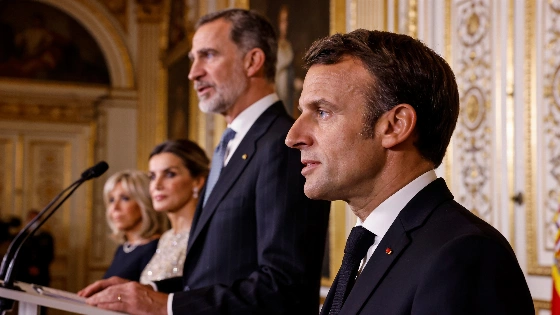
More than 80,000 people reached Ceuta on 30 and 31 July. During Emmanuel Macron's state visit, Felipe VI called the arrivals unacceptable and urged the European Union to share responsibility for defending the autonomous city, describing them as a mass intrusion across Spain's and Europe's border. Interior Minister Fernando Grande Marlaska was in the audience as the government's handling of the crisis faced its most senior public criticism.
His appeal came on a difficult day for Madrid and Paris.
Hours before the state dinner, the Senate rejected the Treaty of Friendship and Cooperation between Spain and France. The Partido Popular used its absolute majority to block it. The vote was 106 in favour, 142 against and one abstention.
The lower chamber had already approved the agreement. The Constitutional Court had endorsed it the previous week, but that ruling did not secure approval in the upper chamber.
The treaty now faces another stage. Congress and the Senate must try to reconcile their positions through a Joint Commission before the text returns for fresh votes. RTVE reported that the rejection coincided with Macron's state visit to Madrid, turning the parliamentary vote into an immediate diplomatic setback.
The King did not mention the defeat in his speech.
Instead, he said the European Union must become more effective and united in protecting its external frontier. His message was plain: Spain cannot carry alone a responsibility shared by all member states.
Felipe VI also pointed to unfinished work on energy and rail connections, with industrial cooperation still on the agenda. He thanked Macron for supporting European construction and closer Spanish-French ties. He also called for greater European capacity in defence and artificial intelligence.
The earlier Ceuta security report showed how quickly the border crisis had become a central political issue in Spain. The King's intervention gives the dispute a European frame: beyond how Madrid manages the autonomous city, it raises the question of who carries responsibility for the EU's external frontier.
On the same day, European Commissioner for Migration Magnus Brunner presented plans to strengthen control of the EU’s external borders, the European Commission said. The proposals included expanding Frontex’s mandate and creating a permanent corps able to deploy rapidly. That shifted the discussion from Spain’s immediate burden towards a broader European border policy.
Macron attended the dinner wearing the collar of the Order of Isabel la Católica. Brigitte Macron received its Grand Cross. The honours accompanied the French president's first state visit to Spain since he arrived at the Élysée in 2017, although the four leaders had already appeared together at official events.
Letizia and Brigitte Macron featured in the ceremonial programme alongside the political message. They appeared together at the reception in the Plaza de la Armería. The two heads of state reviewed the Royal Guard and listened to both national anthems.
Information from ¡Hola!, the Queen wore a grey Pertegaz dress first used in 2019. Brigitte Macron chose a dusty pink coat dress. The delegation later moved to Zarzuela for lunch, after which Felipe VI and Macron held a private meeting.
The palace dinner brought another change of clothes. Letizia wore a pale blue Carolina Herrera dress with the floral tiara. Brigitte Macron appeared in a white dress with silver applications.
Their joint public appearances are not new. The four visited a Joan Miró exhibition in Paris in 2018. Letizia hosted Brigitte's programme during the 2022 NATO summit in Madrid. This visit included no announced parallel cultural or educational programme for the two women.
On Wednesday, Felipe VI and Macron are due to attend a Spain-France trade and investment forum. Macron will also meet Pedro Sánchez. Later that evening, he and Brigitte Macron will host the Spanish royal couple at the French Embassy residence in Madrid. The programme does not include an address by Macron to Congress and the Senate.
Macron did not comment publicly on the Senate's rejection during the dinner. Reports on the visit said he and his delegation continued to signal political support for bilateral relations.
The palace offered ceremony and promises of closer cooperation, while the Senate exposed a concrete obstacle to the bilateral treaty.
Felipe VI framed Ceuta as a test of European solidarity, with responsibility extending beyond Spain. His appeal linked the border crisis to the EU's shared external frontier and placed the unresolved Madrid-Paris agreement under the same scrutiny.