Alberto Núñez Feijoo backs the European Parliament resolution on Ceuta, saying the border crisis exposed a failure of government. He has also announced a security plan for the autonomous cities.
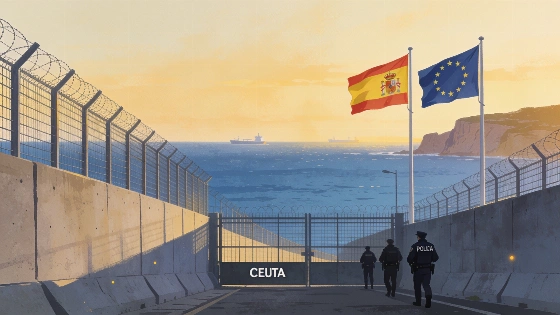
Alberto Núñez Feijoo has turned the Ceuta border crisis into a direct challenge to the Spanish government. Speaking in Melilla after a meeting of the PP’s regional leadership, he backed a European Parliament resolution adopted after the mass entry of migrants through the Ceuta border. He also announced a security plan for Ceuta and Melilla.
The resolution called for stronger protection of the EU’s external borders and expressed support for the people of Ceuta and Melilla. It also addressed sovereignty, border control, returns and migration cooperation. The European Parliament’s official description was more cautious than some media reports, which used terms such as “invasion” and “hybrid warfare”.
The European Parliament adopted the Ceuta resolution on 17 September 2026 by 339 votes to 225, with 16 abstentions.
Feijoo’s central argument was that Ceuta did not face a conventional immigration problem.
He said the episode amounted to an assault on the structure of the Spanish state and described it as the greatest embarrassment Spain had experienced in living memory. His language placed sovereignty and territorial control above the narrower debate over migration management.
The PP leader spoke in Melilla alongside Juan José Imbroda, president of the autonomous city. He referred to the situation in Ceuta fifty days after the mass illegal entry and argued that the disorder there was still complete. That linked the security plan to an unresolved political confrontation rather than presenting it as a routine administrative measure.
According to the European Parliament’s official press release, the resolution calls for stronger police and security forces in Ceuta because public order and safety remained at risk after the events at the end of July. It also calls for faster returns of people who have no right to remain in the EU and tighter control of the external border.
Feijoo also attacked the government’s conduct throughout the crisis. He said the opposition had obtained in Europe what the government itself had voted against, turning the parliamentary resolution into evidence for his broader charge that Spain was still a country without a government. The PP’s own account presented the vote as a condemnation of the crisis and a demand to clarify responsibility, while the resolution itself did not directly condemn Morocco.
His criticism also focused on the images of unrest and the pressure placed on security forces during the episode. In that framing, the border was not only the scene of a migration emergency but also the point where institutional authority had been tested. The events of 30–31 July 2026 remain the central reference point for the parliamentary resolution and the subsequent political reaction.
The resolution also asked for possible involvement by state and non-state actors in those events to be examined. The distinction matters: reports about the vote linked the episode to the possible instrumentalisation of migration as a form of pressure on the EU border, but the official parliamentary description did not amount to a direct finding that Morocco was responsible.
The PP’s presentation fits a wider pattern of political confrontation over Spain’s territorial and social cohesion.