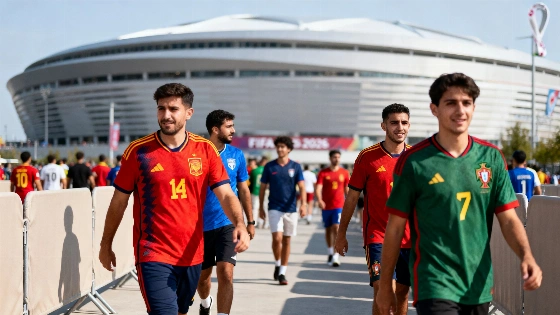
The 2030 FIFA World Cup will be hosted across Europe, Africa and South America. Spain, Portugal and Morocco lead the main bid, with matches also set for Uruguay, Argentina and Paraguay. The tournament may see a record number of teams.
The 2030 FIFA World Cup will mark a turning point in the tournament's history, as the event is set to be staged across three continents and involve an unprecedented number of host nations. FIFA has officially confirmed that Spain, Portugal and Morocco will jointly organize the majority of the matches, while select games will also take place in Uruguay, Argentina and Paraguay to commemorate the centenary of the first World Cup held in 1930.
This decision follows the ongoing trend of expanding the tournament's reach. The 2026 edition, currently underway in North America, already features three host countries—Canada, the United States and Mexico—and has increased the number of participating teams from 32 to 48. The 2030 tournament is expected to push these boundaries even further, with discussions ongoing about a possible expansion to 64 teams, although this has not yet been finalized by FIFA.
For Spain, the announcement means a return to the global football spotlight, as the country last hosted the World Cup in 1982. Portugal and Morocco will also make history: Portugal will host World Cup matches for the first time, while Morocco becomes the first African nation to co-host since South Africa in 2010. The inclusion of South American venues—specifically Montevideo's Estadio Centenario, Buenos Aires and Asunción—serves as a symbolic gesture to honor the origins of the tournament.
The selection process for 2030 was shaped by a joint bid initially led by Spain and Portugal, later joined by Morocco. This cross-continental approach is unprecedented, reflecting FIFA's ambition to celebrate the centenary with a truly global event. The move also comes amid ongoing debates about the logistics and environmental impact of such a widespread tournament, as well as the challenges of coordinating matches across different continents and time zones.
While the focus is now on the expanded format and the unique hosting arrangement, attention has also turned to the future. FIFA has already awarded the 2034 World Cup to Saudi Arabia, signaling a return to the single-host model after two consecutive tournaments with multiple hosts. The evolution of the World Cup format and hosting strategy continues to generate discussion within the football community and beyond.
In the context of major international sporting events, the decision to distribute matches across continents is not without precedent. For example, the MotoGP calendar recently saw the return of the Brno circuit after a four-year break, as highlighted in a recent report on the shifting landscape of global sports venues. Such developments underscore the increasing complexity and ambition of organizing world-class competitions in the modern era.
According to Telemundo Chicago, the 2030 World Cup will not only celebrate a century of football history but also test the limits of international cooperation in sports. The final number of participating teams remains under discussion, and the full schedule of matches across the six host nations is yet to be detailed. What is clear is that the 2030 tournament will set new benchmarks for scale, diversity and logistical coordination in world football.
For reference, the 2002 World Cup was the first to be co-hosted, by South Korea and Japan, and Brazil emerged as champions. Since then, FIFA has gradually embraced multi-nation formats, culminating in the current plans for 2030. The event is expected to draw significant attention from fans, broadcasters and sponsors, with Spain, Portugal and Morocco at the center of this historic sporting milestone.