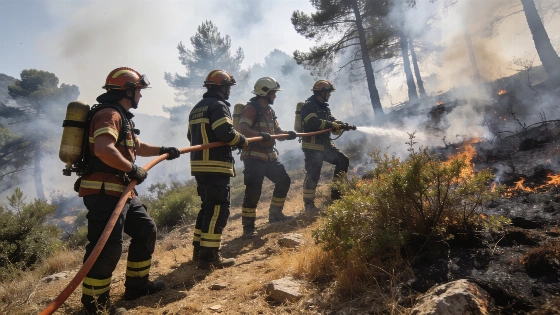
A impressive wildfire broke out early this afternoon on the slopes of Sant Pere Màrtir in the Collserola Natural Park, within the municipality of Esplugues de Llobregat, Barcelona. Emergency services received the first alert at 15:35, prompting a swift response from local and regional firefighting teams. The fire was reported on 14 August 2026.
Initial reports placed the fire’s likely starting point near the Carretera de les Aigües, a popular route in the Collserola hills. Around 20 firefighting units joined the response, with support from ground crews and aircraft. The Bombers de Barcelona worked alongside the Bombers de la Generalitat, which sent 10 ground vehicles and two helicopters, one for water-bombing and one MAER helicopter.
Crews worked to contain the blaze and keep it from spreading into the surrounding woodland. Rugged terrain and dry conditions complicated the operation, requiring coordination among emergency services. No injuries or evacuations had been reported at the time of the initial account, and authorities continued to monitor the situation.
In a report published at 19:01 on the day of the fire, journalist Gisela Macedo of La Opinión de Zamora reported that Guardia Urbana officers had detained a suspect allegedly connected to starting the Collserola fire. The detention is part of the police investigation; it is an allegation, not a judicial finding of guilt.
The fire’s location near Esplugues later became part of a wider set of access controls affecting the Collserola massif. In October, Catalan authorities were discussing a phased reopening after restrictions covered a high-risk perimeter across 19 municipalities, including Esplugues. The measures were part of a broader environmental and public-safety response, including controls linked to African swine fever, rather than the wildfire alone. CatalunyaPress reported that officials had analysed 14,101 samples, with 410 positive results and nearly 13,700 negative tests.
Other figures from the animal-disease response show the scale of that separate effort: more than 13,300 wild boars had been captured, while the estimated density in the “zone 0” had fallen below one animal per square kilometre, down from about 20 at the height of the emergency. 20minutos reported that, from 7 August, all but one positive result came from remains of dead animals found by detection dogs. These figures concern disease surveillance, not the fire’s size or damage.
Barcelona’s municipal broadcaster Betevé reported in October that the government aimed to reopen Collserola by the end of the year through designated safe corridors. The park had been closed for seven months, while restrictions lasted 11 months in some areas. The Carretera de les Aigües was identified as a priority route for managed reopening. Businesses affected by the restrictions reported revenue declines of 10% to 15%, showing the wider local impact of prolonged access limits.
This incident came amid other disruptions to Catalonia’s transport network, including traffic chaos on the AP7 after a truck accident that caused extensive delays and road closures. For more details, see the report on the AP7 accident that caused impressive traffic jams in Alt Penedès.
Collserola is one of the largest green spaces near Barcelona and a critical natural buffer for the metropolitan area. Wildfires are a recurring concern during warmer months, when dry vegetation and wind can help flames spread. Residents were advised to follow official updates and avoid affected areas while emergency operations continued.