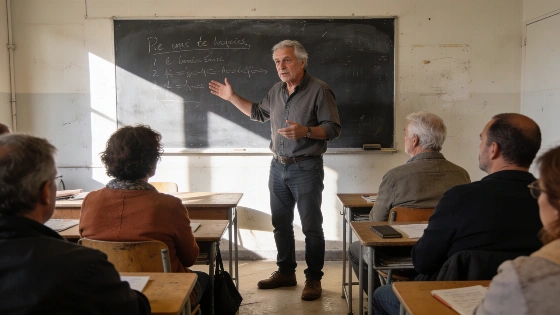
Joël, a French secondary school teacher, retired at 61 after nearly 30 years in public education. He now receives a net pension of €2,454 per month and volunteers teaching French to foreigners. His case highlights the complexities of early retirement rules in France.
Joël stepped out of the classroom for the last time in June 2021, closing a chapter on almost thirty years in France’s public education system. At 61, he had completed all the required quarters for a full pension, allowing him to retire before the standard age. Today, he receives €2,454 net per month, a figure that stands out in the ongoing debate about pensions and retirement age in France.
According to his account published by Figaro Emploi, Joël’s final gross salary as a certified secondary school teacher was around €3,200 per month, including an annual bonus for working in REP+ schools—institutions serving students from disadvantaged backgrounds. His pension, calculated at €2,700 gross (or €2,454 net), is only €46 less than his last net salary, a difference of just 1.84%. However, this near-parity is specific to his career path and cannot be generalized to all teachers.
Career in Challenging Schools
Joël began his career in the Paris region, mainly in Essonne, after passing the CAPES national exam that grants access to the French civil service teaching corps. For a decade, he worked in REP+ schools, where many students spoke languages other than French at home. Later, he moved to Vendée and finished his career in La Roche-sur-Yon, with his final lesson dedicated to Maupassant’s Bel-Ami.
The REP+ bonus, which currently reaches up to €5,816 gross annually for full-time work, was part of his last salary but is not fully included in the basic pension calculation. Instead, such bonuses contribute to the complementary RAFP pension, capped at 20% of the base salary. This system means that while REP+ work is recognized, it does not dramatically boost retirement income.
Early Retirement and Legal Nuances
Joël’s retirement at 61 was possible because he had validated all required quarters for a full-rate pension. However, the legal framework for early retirement is complex. Officially, the minimum retirement age for sedentary civil servants born between 1959 and 1960 is 62, with 167 quarters needed for a full pension. The article does not specify which legal provision allowed Joël to retire a year early, making it clear that not all teachers could follow the same path under identical conditions.
His retirement occurred before the 2023 French pension reform, which raised the legal retirement age and adjusted contribution requirements. The rules have since changed again, with the legal age set to rise to 64 for those born from 1969 onward. For those born between 1964 and 1968, the minimum age will gradually increase from 62 years and nine months to 63 years and nine months. In Spain, the requirements for retirement age and contributions differ, further complicating direct comparisons.
Volunteering After Retirement
Despite leaving his official post, Joël continues to teach French as a volunteer to adult foreigners at a local social center, dedicating two hours twice a week. This unpaid work echoes similar initiatives in Spain, such as the Andalusian emeritus teacher program, which encourages retired educators to remain involved in education without financial compensation.
Comparing with Spain
For context, a secondary school teacher in Andalusia in 2026 earns a gross monthly salary of €2,997.84 before seniority and other bonuses, according to ANPE data. This includes a base salary, destination allowance, and basic component, with additional increments for years of service. Joël’s pension is net, while the Spanish figure is gross, making direct comparison misleading. Nevertheless, his net pension represents about 98% of his last net salary, a rare outcome in public sector retirements.
Joël’s experience illustrates both the benefits and the legal intricacies of the French pension system for teachers. While his case is not typical, it sheds light on how career choices, bonuses, and timing can significantly affect retirement income. For those considering early retirement in France or comparing systems across Europe, the details matter—and the rules continue to evolve.