Papa Dia’s first steps in Spain began amid uncertainty and a fight to survive. At just 19, he landed on Spanish soil after a week-long journey across the Atlantic from Senegal in a crowded cayuco, accompanied only by his brother and dozens of strangers. The crossing claimed a life before they reached La Gomera, where the Red Cross intervened. Soon after, Papa found himself alone in Madrid. His brother had been sent to Barcelona, leaving him without family, friends, or even a grasp of the Spanish language.
His route by sea differed from Spain’s organized labour-migration programmes, which include seasonal-worker schemes designed to regulate recruitment and employment. The Ministry of Inclusion, Social Security and Migration outlines those programmes as part of its wider structure on migration flows.
“I felt lost,” he recalls. “No papers, no friends, no money, no language. Every day was a fight for my future.” Even basic tasks like shopping became challenges. Determined to adapt, Papa began learning Spanish at a local association on weekends, but work soon made regular classes impossible. He continued on his own, eventually mastering Spanish, along with Wolof, French, and Chinese.
Building a New Life
Papa’s first jobs were humble but impressive. He started as a delivery worker, then moved into the kitchen of a Chinese restaurant. There, he began with the simplest tasks and eventually became a cook specializing in Asian cuisine. The experience brought more than a paycheck: it gave him a new language, savings, and the chance to earn a driver’s license.
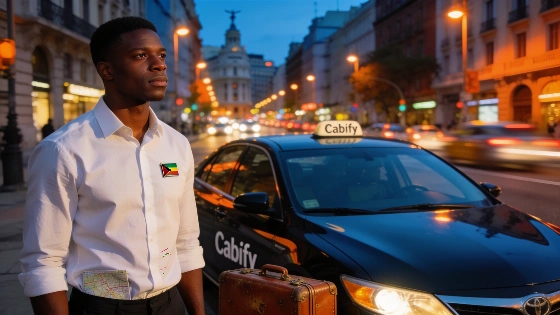
With his license in hand, Papa left the kitchen behind and set his sights on a new career. His first day as a Cabify driver was anything but smooth. Unfamiliar with the app, he struggled to confirm his passenger’s pickup. The client, patient and understanding, guided him through the process. That ride marked the start of his daily life behind the wheel.
App-based work is part of Madrid’s wider mobility field. The regional government’s Madrid Movilidad portal offers studies and resources for people in the sector. Cabify has also described developing digital tools for passengers and drivers. In a company engineering article about its chatbot systems, the team wrote: “Once the multi-agent architecture was running for riders, drivers were the natural next step.”
Standing Out on Madrid’s Roads
Nearly three years later, Papa Dia is recognized as one of Cabify’s top-rated drivers in Madrid, working for Vecttor, a Cabify subsidiary. He follows three principles: dress well, keep the car spotless, and create a welcoming atmosphere. Calm driving is non-negotiable. “When someone gets in my car, they should feel the difference. I represent my company and Cabify,” he says.
Papa adapts each ride to the passenger’s mood: quiet for those who prefer silence, conversation for those who want to talk, or Spanish music for young weekend riders. “A VTC driver is more than a driver; sometimes you’re almost a psychologist,” he explains. For him, personal worries stay outside the car.
Closing the Circle
Years after his dangerous sea crossing, Papa decided to retrace the route, this time by land, driving solo from Madrid to Dakar. He completed the 3,750-kilometer journey in five days. “I’ve traveled between Spain and Senegal by sea, by plane, and now by road, driving myself,” he says with pride.
Looking back, Papa’s advice to his younger self is clear: “Fight and don’t give up. Spain is a country where, if you really want a better future, you can achieve it.”
Talent24h reported Papa Dia’s story.