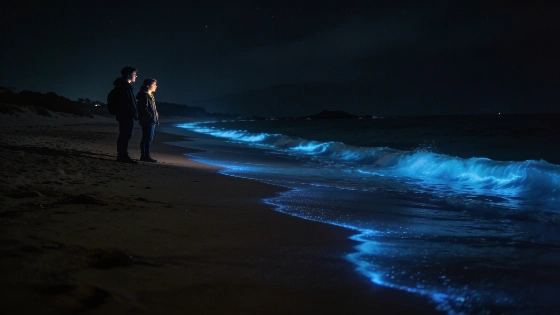
Blue flashes have once again lit up the shores of Galicia, as the elusive 'mar de Ardora' reappears on local beaches. The spectacle depends on darkness, water movement, and the right concentration of microorganisms, making each sighting unpredictable and unique.
On the night of July 15, 2026, the sands of A Lanzada beach between O Grove and Sanxenxo were illuminated by fleeting blue glows, as Galicia’s famed 'mar de Ardora' made a rare return. The phenomenon, which transforms the shoreline into a shimmering spectacle, has reignited interest among locals and visitors hoping to witness the natural light show firsthand.
Unlike scheduled events, the appearance of 'mar de Ardora'—also known as ardentía—remains unpredictable. Its visibility hinges on a delicate balance: a high concentration of bioluminescent microorganisms, warm water temperatures, gentle but active waves, and, crucially, minimal light pollution. Even on nights when conditions seem ideal, there is no guarantee the sea will glow.
What Causes the Blue Glow?
The blue luminescence is triggered by marine microorganisms, most notably Noctiluca scintillans, identified by the Xunta de Galicia as a key contributor. When disturbed by waves, boats, or even a person’s movement, these dinoflagellates emit brief flashes of blue light. The effect can range from faint sparkles at your feet to broad, glowing lines along the surf, depending on the density of the organisms and the state of the sea.
According to marine researchers, these blooms are most common in summer, aligning with the seasonal cycle of phytoplankton. The light is only visible when the water is agitated, so the sea may appear dark for long stretches before suddenly lighting up with a passing wave.
Best Conditions for Viewing
The window for observing bioluminescence in Galicia typically runs from June to September. For the best chance of seeing the phenomenon, experts recommend seeking out beaches far from artificial lights on moonless or nearly moonless nights. Allowing your eyes to adjust to the darkness is essential, as even a brief flash from a phone or flashlight can diminish the effect.
Ideal conditions include a calm but moving sea, clear skies, and patience—since the glow can appear and vanish unpredictably. It’s also important to remember that a beach that sparkled one night may be completely dark the next, while another nearby location could suddenly come alive with light.
Where to Find 'Mar de Ardora'
While A Lanzada has already seen activity this July, other Galician beaches are also known for occasional displays. The Costa da Morte region, with its low light pollution, is home to spots like Carnota, Nemiña, Balarés, Rebordelo, Estorde, and O Rostro. The beach of As Catedrais in Lugo is also mentioned among possible locations. However, no site offers certainty—each visit is a gamble, and the phenomenon remains as elusive as ever.
For those planning a night excursion, arriving before sunset to scout a dark, safe vantage point is advised. Observers often combine the search for bioluminescence with visits to other northern beaches, but moving from one spot to another does not guarantee success. The experience is as much about patience and luck as it is about planning.
How to Observe Responsibly
To catch the 'mar de Ardora', focus on the breaking waves or gently stir the water at the shoreline with your feet or hands. There’s no need to wade in—often, the glow is visible from the sand. Keeping all artificial lights off helps your eyes adjust and increases your chances of spotting even faint flashes.
Respect for the environment is crucial. Avoid disturbing the seabed, leave no litter, and refrain from actions that could harm the delicate ecosystem. The growing popularity of the phenomenon, fueled by viral summer photos, makes responsible observation more important than ever.
For those interested in other remarkable marine events, the Atlantic has recently seen the return of Contender, the largest recorded great white shark in the region, as detailed in this report on Atlantic marine life.
Further scientific background on Noctiluca scintillans and the 'mar de Ardora' can be found through official resources provided by the Xunta de Galicia.