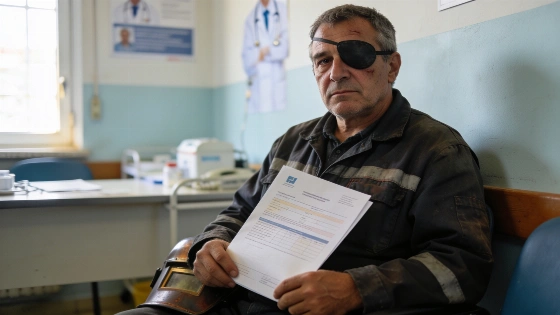
A Galician welder who lost sight in one eye has won a second period of sick leave after the INSS tried to block his claim. The court ruled his psychiatric diagnosis was a separate illness, overturning the agency’s refusal and clarifying the rules for workers with complex recoveries.
After 545 days on medical leave and a failed attempt to secure permanent disability, a Galician welder found himself in a legal dispute with the INSS. The agency ordered him back to work, but the courts saw things differently and forced the INSS to reverse its decision.
The conflict began when the INSS denied his request for permanent disability in April 2025, even though he had lost all vision in his right eye. Soon after, his primary care doctor issued a new sick note, this time for a mixed adjustment disorder—a psychiatric condition brought on by the ordeal. The INSS immediately rejected this new leave, arguing it was just a continuation of the same medical process and that the law required a 180-day gap before any new claim.
The Galician High Court explicitly ruled that a psychiatric diagnosis following a physical injury can be recognized as a separate medical process, not subject to the 180-day waiting period.
The court disagreed. The Galician High Court (TSJ) ruled that the psychiatric diagnosis was a separate condition, not a relapse or extension of the original eye injury. The judges pointed out that just because two illnesses happen close together in time does not mean they are the same under the law.
Article 174.3 of the General Social Security Law says a new sick leave for the same or similar illness is only allowed after 180 days have passed since the previous process ended. The INSS tried to apply this rule to any diagnosis, but the court made it clear: only identical or closely related conditions trigger the waiting period. In this case, the adjustment disorder was recognized as a new clinical event, so the worker’s right to benefits was restored without delay.
The welder’s medical records showed not only the permanent loss of vision but also serious effects on his daily life and mental health. The court’s decision forced the INSS to accept the new sick leave, allowing the worker to keep receiving payments while he recovered from the psychological impact of his injury.
According to a recent publication summarizing the case, the INSS had refused to recognize permanent disability for the worker in April 2025, even after he lost all vision in his right eye. Only after a primary care physician issued a new sick leave for adjustment disorder did the legal dispute escalate, highlighting the importance of distinguishing between physical and psychiatric conditions in social security law.
This is not the first time Galician authorities have had to clarify the rules around sick leave and disability. As with the earlier yacht incident off Vigo, the details matter: each case depends on precise diagnoses, timelines, and whether institutions follow the law as written.
Later, in a separate case, a Vigo labor court granted the welder full permanent disability in October 2025, reflecting the seriousness of his condition. However, the TSJ’s ruling focused only on the legitimacy of the psychiatric sick leave, not the broader question of long-term incapacity.
For workers facing complicated recoveries, this case makes one point clear: the INSS cannot automatically block new sick leave claims by treating different medical issues as the same. Each diagnosis must be considered on its own, and the law’s safeguards against abuse cannot be used to deny real support. The court’s decision highlights the limits of the system and shows that public agencies can be held accountable when challenged by workers and attentive judges.