Germany's industrial engine is losing power as the AfD advances. The CDU is weakened, while pressure grows over jobs, energy and Europe's direction.
Germany's industrial engine is under pressure from a deepening car crisis and the AfD's rapid advance. Up to 150,000 automotive jobs could disappear as manufacturers move slowly toward electric vehicles and struggle to build the software they need. The CDU has also suffered a debacle in Alta Sajonia and Mecklemburgo-Pomerania. The Bundesbank reported weaker economic momentum in the third quarter of 2026. Industrial production and sales fell noticeably in July.
This is more than a difficult election cycle. Germany's economic model has supported Europe's industrial strength and political weight for almost six decades. Its decline now puts pressure on the European budget, joint defence against the Kremlin, and the energy and industrial policies needed to respond to China's technological advance. The labour market is already showing the strain. German employment fell to 45.66 million, while August unemployment reached 2.996 million, or 6.4%, according to the Bundesbank.
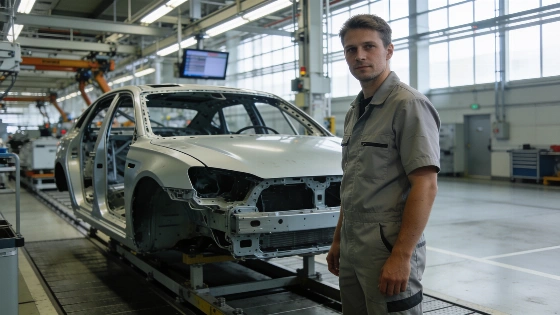
Employment in Germany’s automotive sector has fallen from around 830,000 people in 2018 to fewer than 700,000 today, according to industry estimates cited by Focus. A further decline to about 500,000 jobs by 2030 has been projected.
The immediate economic problem is concentrated in the automotive sector. The move to electric vehicles has been slow. Software development came late, and production costs have risen. These pressures have left factories and jobs open to populist messages that offer simple answers to problems the established parties have not solved. The Bundesbank cautioned that July's weak output was not caused only by long-term structural problems. One car plant stopped for several weeks while it was converted to electric-vehicle production. Output was expected to return to normal from August.
The AfD has gained from the pressure. The source material describes the party as populist, xenophobic, racist, eurosceptic and pro-Russian. Its gains came as the CDU lost ground in the affected elections. The comparison with the problems faced by Vox and the Partido Popular in Spain has followed. Reuters reported that the CDU suffered heavy losses in two eastern German states. The AfD became the strongest party in Mecklemburgo-Pomerania.
Friedrich Merz remains weak as CDU leader. No alternative figure inside the party has emerged who can confront the crisis. Germany is dealing with an industrial challenge and a leadership problem at the same time. The party long associated with stability is being tested as economic insecurity strengthens its most radical rival.
In Mecklemburgo-Pomerania, the AfD won about 38% of the vote and nearly doubled its result compared with the previous state election. DW and NPR described the result as a major setback for the CDU and a further sign of the AfD’s strength in eastern Germany.
The contrast with Germany's post-war recovery is sharp. In 1966, authorities from Francoism and the Federal Republic of Germany opened the exhibition "Alemania y su industria" in Madrid. It presented German technological strength and the so-called German miracle after the destruction of Nazism.
Konrad Adenauer and Ludwig Erhard built a liberal system with a strong social foundation. The Marshall Plan helped speed the recovery and made Germany the envy of Europe. More than 600,000 Spaniards emigrated to Germany for work during the 1960s and 1970s. Their labour helped fuel the country's development.
The model also depended on political agreements with the SPD. For years, Germany combined industrial power with economic influence and a central role in Europe. That formula is now under strain. The AfD is rising, the CDU is weak, and the industrial transition has shown the cost of falling behind in technology.
There is still some reason for optimism. Germany is expected to grow by 1.8% of GDP in 2026, six tenths above the previous forecast. More cautious September estimates put the BDI forecast at 1.0%, up from 0.6%. A joint economic forecast expected growth of 1.3%. Public spending and stronger exports are expected to offset the energy crisis caused by the war in Iran. That improvement does not remove the pressure on factories or the political space opened by job losses. Major European institutions have also made technology a defensive priority, as shown by this earlier technology report.
Germany is facing more than a single downturn. Industrial weakness is colliding with political fragmentation. Growth may buy time, but it cannot replace competitiveness. Public money can soften the shock, yet it cannot restore the old model on its own. The AfD is advancing because the economic transition has created visible costs and the CDU has not shown convincing leadership. Chancellor Friedrich Merz called the election result catastrophic for his party, according to NBC News, but said reforms would continue. Germany's crisis is therefore a European problem, not a domestic footnote. If Germany falls, the whole of Europe will tremble.