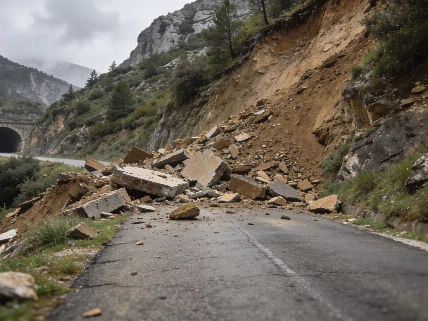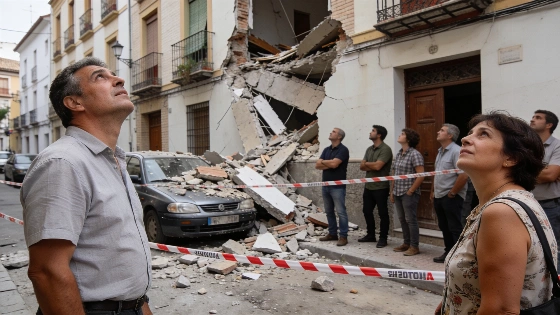
A magnitude-4.8 earthquake struck 10 kilometers south of Granada on Tuesday morning, leaving at least three people with minor injuries and visibly damaging buildings and vehicles, information from the National Geographic Institute (IGN). The tremor hit near Alhendín at 10:37 local time. Emergency services responded as residents rushed into the streets, fearing further aftershocks.
Several public buildings, including museums and sports centers, as well as administrative offices, closed for safety checks. The Alhambra palace, a UNESCO World Heritage Site and major tourist destination, suspended visits for the afternoon. The landmark typically welcomes millions of visitors each year.
Local reports described scenes of panic as people evacuated homes and workplaces. Falling debris damaged parked cars, and authorities warned of possible delays on the Granada metro. As a precaution, the metro reduced train speeds to 30 km/h. The IGN said the tremor was the latest in a series of shallow earthquakes affecting the region since the previous Friday, all widely felt by residents.
The August seismic sequence began on 14 August, followed by a magnitude-5.0 earthquake centered in Alhendín on 15 August. That shock was felt as far away as Murcia, Madrid and Extremadura, damaged buildings and caused damage inside five Granada churches. A magnitude-4.8 event followed days later, with aftershocks reaching magnitude 4.2. Local reporting recorded 445 incidents handled by Granada city council during the sequence. The magnitude-5.0 earthquake caused no reported casualties, while the later events were associated with at least three minor injuries.
Eyewitnesses described the quake as noticeably stronger than earlier minor tremors in the area. One resident said the shaking was intense enough to send items crashing down inside buildings. Another described the fear of experiencing it while shopping in a local supermarket. The earthquake was recorded at a depth of less than 10 kilometers, increasing the intensity of the shaking at the surface.
Further tremors continued to affect the metropolitan area. On 18 October, the IGN recorded a magnitude-1.9 earthquake near Vegas del Genil at 08:41 and a magnitude-2.8 event near Cájar. The shocks were felt in more than a dozen municipalities, including Granada, Armilla and Alhendín, as well as Cenes de la Vega, Churriana de la Vega, Cúllar Vega, Las Gabias, Gójar, Maracena, Ogíjares and Huétor Vega. Reported intensities ranged from II to IV, and no material damage was reported from either event. The Cájar quake was initially listed at zero kilometers deep, while another local report gave a provisional depth of three kilometers.
The wider sequence has also brought a large compensation burden. By 20 October, Spain’s Consorcio de Compensación de Seguros had received 70,150 claims for earthquake-related losses: 70,061 for material damage and 89 for business interruption. It had paid 14,393 claims, or 20.5 percent, totaling €52,099,124, against a preliminary damage estimate exceeding €209 million. Claims included 1,207 from Alhendín, 1,997 from Maracena and 1,656 from Vegas del Genil.
Granada and its surroundings have a history of seismic activity, with repeated events recorded across the metropolitan belt, including Cájar and Vegas del Genil, as well as Armilla and Alhendín. The recent sequence has heightened local concern and renewed attention to building safety and emergency preparedness. As detailed in a previous report on seismic activity in the Granada region, an earlier quake in Alhendín caused no injuries or major damage.
Spain’s southern regions, particularly Andalusia, are periodically affected by moderate seismic events. The Alhambra’s temporary closure and the ongoing compensation process show how earthquakes can disrupt residents and public services, while also affecting tourism, local businesses and daily life across the metropolitan area.