Plaza Nueva, the Carrera del Darro and Lorca's Granada all appear in La bola negra, Spain's international feature submission for the 2027 Oscars. The Javis used the city's streets, gardens and historic sites to build the film's world.
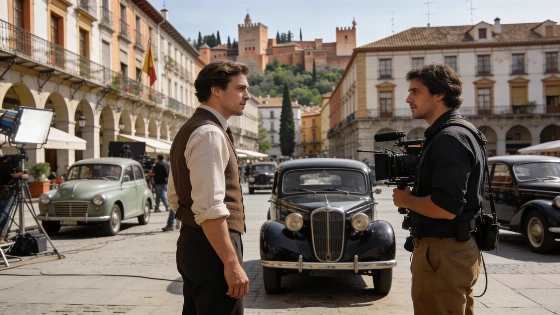
Plaza Nueva and Plaza de Santa Ana were reset to look like Granada in 1932. Period cars, republican flags, costumed extras and altered street details changed the central setting for the shoot.
La bola negra will represent Spain in the international feature film category at the 2027 Oscars. Javier Calvo and Javier Ambrossi, known as Los Javis, directed the film. It draws on an unfinished work by Federico García Lorca.
Filming at Plaza de Santa Ana was coordinated with the ecclesiastical authorities of the San Gil y Santa Ana parish, adding a layer of local institutional coordination to the production’s use of Granada’s historic spaces.
The route continues along the Carrera del Darro. Historic buildings, stone bridges and views towards the Alhambra give the film a setting that viewers can recognise at once. The architecture carries much of the visual work. The production did not need large sets for these scenes.
Ideal and 20minutos list these central Granada locations among the film's main shooting sites. Their reports also describe how the city was used to recreate the atmosphere of the early 1930s.
The Oscar selection has brought fresh attention to those places. Granada's streets now form part of the film's public story, not just its backdrop.
The Albaicín supplied another major setting. Its cobbled streets, whitewashed houses, small squares and steep slopes offer a version of Granada that feels exact and timeless.
The production’s geography extends beyond Granada to Sierra Nevada and to locations including Oyambre, Comillas and Castil de Carrias. These sites add a broader national dimension while leaving Granada as the film’s central visual and historical axis.
The link with Lorca becomes direct at sites tied to his life and death. Canal Sur's account of the Granada route includes Huerta de San Vicente and the Barranco de Víznar. Both places connect the film's locations with the writer's biography.
La Huerta de San Vicente was the García Lorca family's summer residence between 1926 and 1936. It still holds original furniture and the piano used by the writer.
The route also reaches the Víznar ravine, a place tied to the poet's memory. Together, these sites connect the production with the life of the figure whose unfinished work inspired it.
The public interest around the film has grown. Earlier coverage examined that rise. Antena 3 reported that Calvo and Ambrossi described the project as a story approached with empathy. They also said they want audiences to leave the cinema changed.
That helps explain the role of the Lorca-related locations. They are not simply period scenery. They carry part of the film's argument.
The shoot reached well beyond Andalusia. The production travelled to Comillas and Valdáliga in Cantabria, Castil de Carrias in Burgos, Sigüenza in Guadalajara, Madrid and Greece.
Granada remains the clearest centre of the film's geography. Its streets bring together the city's history, Lorca's memory and the visual language of the production.
That is what gives the Oscar campaign a local weight. La bola negra presents Granada as part of the story itself. Its streets and historic spaces carry the period atmosphere and the Lorca connection toward the 2027 awards.