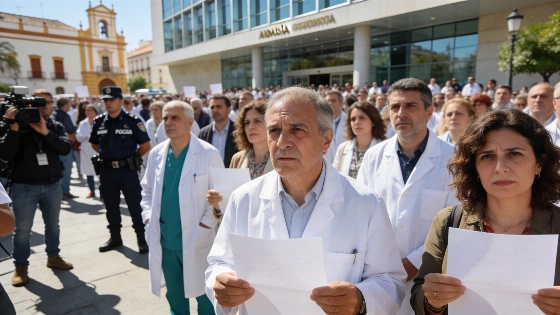
Healthcare Crisis in Andalusia: Why Public Dissatisfaction Doesn't Affect Elections. Healthcare remains the main concern for residents of Andalusia. Despite widespread discontent and a rise in private insurance policies, political approval ratings among those in power remain virtually unchanged. Experts explain why protests are not impacting election outcomes.
Andalusia continues to experience a severe crisis in its healthcare system: surgery waiting lists are growing, emergency services are overwhelmed, and, according to many experts, the primary care network has effectively lost its purpose. Despite an increase of over 55% in the healthcare budget in recent years and a rise in the number of medical staff, the situation for patients has not improved. According to recent surveys, healthcare has become the region’s main problem for residents, surpassing even unemployment.
Distrust of Change
However, widespread dissatisfaction has not led to a drop in the current government’s approval ratings. According to political scientists, most residents do not believe that any party can quickly solve the accumulated problems. As a result, even large-scale protests organized by the Marea Blanca movement and the Amama association have little noticeable impact on the ruling party's electoral position. Experts note that many voters see the healthcare situation as chronic and unsolvable, and some of the population prefer to take out private insurance; their number has risen by almost 27% since 2019.
Division of Opinion and Political Struggle
Perception of the problem also depends on political preferences. More than 60% of left-wing party supporters name healthcare as their main cause for concern, while among voters for the ruling party this figure does not exceed a third. At the same time, according to data from the Andalusian Research Center, most respondents believe that the current government is better than others at managing the crisis. Against this background, the opposition is focusing on criticizing the healthcare system, but analysts say it is unable to convince the broader public of its ability to change the situation. Socialist candidate María Jesús Montero faces distrust due to her previous role in the regional government and a lack of notable achievements as finance minister.
Reaction of the professional community
Professional medical associations and patients continue to express dissatisfaction. Representatives of Sindicato Médico Andaluz and Justicia por la Sanidad emphasize that none of the parties that have governed the region succeeded in achieving sustainable improvements. Despite increased funding and new staffing decisions, surgery waiting lists in Andalusia remain among the longest in the country. A surge in protests linked to failures in the screening program forced authorities to change leadership in the health ministry and promise reforms, however, during the election campaign these issues are hardly being raised.
Local protests and public initiative
Residents of the region are not willing to put up with the situation. Activists from Amama and Marea Blanca are holding demonstrations outside public television buildings and launching initiatives to draw attention to the problems faced by patients affected by failures in the system. According to the leaders of these movements, real discontent in towns and villages is much higher than polls indicate. At the same time, as russpain.com notes, similar conflicts over healthcare have already led to a change of power in the region, but now public pressure is not as effective as it was ten years ago. In the article about repeating the strategies of former governors of Andalusia it is analyzed in detail why the management style and rhetoric of the authorities have changed little, despite the shift in political forces.
Attempts at stabilization
Regional authorities claim that after the change in leadership and the signing of new agreements with the medical community, tensions have eased. At the same time, representatives of trade unions and patient organizations note that structural problems remain unresolved, and the promised reforms have yet to be implemented. Against this backdrop, the opposition continues to use the healthcare issue to mobilize its supporters, but has been unable to reverse the general trend of distrust towards rapid change.