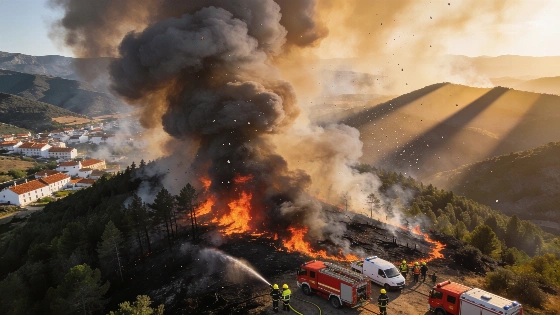
The wildfire that erupted near La Mierla in Guadalajara province on July 16, 2026, was initially reported to have burned 26,000 hectares, making it the largest blaze recorded in Castilla-La Mancha. Final figures put the affected area at 34,447 hectares, mainly within the Sierra Norte de Guadalajara Natural Park. The fire remained officially active for 51 days, until September 4. Initial emergency updates said 1,200 people had been evacuated from 28 villages as the perimeter expanded to 120 kilometers and the fire advanced roughly 10 kilometers overnight. Regional authorities warned that worsening weather could complicate containment efforts and stepped up firefighting resources.
On Monday morning, the situation deteriorated further, leading to the evacuation of six additional communities: Riofrío del Llano, La Bodera, Cardeñosa, Rebollosa de Jadraque, Angón, and Santiuste. Information from the Guardia Civil, these latest evacuations affected 265 residents. Officials said at the time that no homes had been damaged and that protecting villages at risk remained the priority. Mercedes Gómez, Castilla-La Mancha’s regional minister for Sustainable Development, said at the Advanced Command Post in Tamajón that safeguarding residents and their property was the basic concern. Later accounts put the total number evacuated at about 1,500 people across 34 localities; 14 other settlements were confined.
Most of the burned area lies within the Sierra Norte de Guadalajara Natural Park, a protected field with ecological value and communities that depend on forestry and livestock, with tourism also impressive. Local accommodation providers reported cancellations after preparing for the August solar eclipse. During the emergency, authorities also arranged controlled access for livestock owners to feed their animals. After the fire, forest firefighters walked a 75-kilometer route through the burned area to document damage and call for restoration. Firefighter Juan Jorge de la Rosa said the aim was to share “the journey” with residents and let them describe “everything they have lost.” The organizing group also called for “the recovery of the territory” and a professional model for wildfire prevention and suppression.
The cause remained under judicial investigation three months after the fire began. Early accounts linked the outbreak to harvesting work involving a combine harvester, but no final determination of the cause had been announced. The government’s subdelegate in Guadalajara declined to discuss it publicly, saying the matter “is already in court.” Castilla-La Mancha’s Department of Sustainable Development said it planned to join the proceedings and was preparing a damage report. The investigation had not established responsibility for the fire.
The fire’s effects continued after its official extinction. Cadena SER reported ozone peaks and wildlife displacement, including wolves and their young moving toward nearby areas such as Torrevaldealmendras, in the municipality of Sigüenza. The Provincial Association of Farmers and Livestock Breeders (APAG) reported that ten sheep had been killed in an attack attributed to wolves displaced by the fire. These impacts added pressure on ecosystems and local livestock farming as communities began considering recovery.
Almost two months after the fire was extinguished, forest firefighters and residents used the 75-kilometer route to document losses and press for the Sierra Norte’s restoration. The fire was also commemorated at the 19th Día de la Sierra, held in Bustares on October 17, 2026, in tribute to those who fought the blaze and helped affected municipalities. Nueva Alcarria reported an estimate of about 32,000 hectares burned at the time; the final figure reported elsewhere was 34,447 hectares. Both accounts describe a fire of exceptional scale for the region.
This incident follows a series of severe wildfires in the region in recent years. A previous blaze in Sierra Norte forced the evacuation of 529 people and burned more than 3,400 hectares, as detailed in a recent report on earlier evacuations and fire spread in Guadalajara. The current fire surpassed previous records for the area in its scale and the number of people displaced.
Wildfires are a recurring threat in Spain, particularly during periods of high temperatures and dry conditions. The Sierra Norte Natural Park is home to diverse flora and fauna and supports local livelihoods through rural tourism and agriculture. The destruction of 34,447 hectares has left a large restoration challenge. The post-fire walk through the burned field was intended both to document damage and to give residents an chance to describe their losses, while regional and national authorities coordinated support for affected communities.