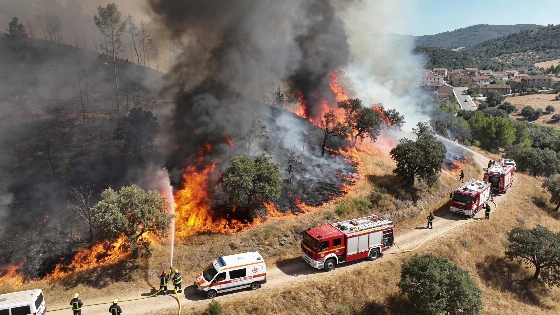
A major wildfire in Sierra Norte de Guadalajara has led to the evacuation of 11 villages. Over 3,400 hectares have burned. Authorities struggle to contain the fire as strong winds and heat complicate efforts.
The wildfire raging in the Sierra Norte region of Guadalajara has triggered the evacuation of 529 residents from 11 municipalities, with the fire now consuming nearly 3,500 hectares. Emergency teams remain unable to contain the blaze, which continues to threaten both homes and protected natural areas as high winds and soaring temperatures fuel its advance.
Evacuations began on Thursday and have since expanded to include La Mierla, Muriel, La Nava de Jadraque, Almiruete, Semillas, Palancares, Umbralejo, Navas de Jadraque, El Ordial, Arroyo de las Fraguas, and Zarzuela de Jadraque. Most evacuees have found shelter with relatives, while 80 people are being housed in a Red Cross shelter in Humanes, including 47 children from a summer camp. The fire, which started at 13:55 on Thursday in La Mierla, was reportedly sparked by a combine harvester operating in the area.
Authorities have identified an agricultural worker from Robledillo de Mohernando as the main suspect in the investigation, with the Civil Guard taking statements from local machinery owners. The individual under scrutiny is also the mayor representing Vox in the municipality. The regional government has emphasized the need to establish responsibility, while the local farmers' association, APAG, has defended the worker, arguing that agricultural activity was permitted under the current regulations at the time the fire broke out.
Restrictions on the use of agricultural machinery are a point of contention. APAG has called for the removal of the Castilla-La Mancha Fire Propagation Index (IPP), which limits outdoor activities during periods of high fire risk. The regional government, however, insists that the index is essential for protecting both people and the environment, especially given the ecological value of the Sierra Norte Natural Park, now directly affected by the flames.
Firefighting efforts have involved more than 500 personnel and over 100 vehicles and aircraft, but the complex terrain and gusts exceeding 40 km/h have hampered progress. According to regional officials, the fire is spreading at a rate of 50 hectares per hour. The main focus remains on defending urban centers and preventing the fire from reaching residential areas. Authorities hope for a break in the weather overnight but warn that extreme fire risk will persist across the region.
Support has arrived from the Community of Madrid, which has sent four ground units and a command team after conditions improved at a separate fire in Lozoyuela. At least ten roads remain closed or restricted due to the ongoing emergency. The president of Castilla-La Mancha, Emiliano García-Page, has updated King Felipe VI on the situation and recalled the tragic 2005 La Riba de Saelices fire, which led to significant changes in Spain's emergency response system.
García-Page stressed that responsibility for wildfires lies with those who break the law, not with any profession or political affiliation. The regional government plans to act as a private prosecutor in the case. For now, officials are focused on containing the fire and minimizing further damage, with investigations into the cause to follow once the emergency is under control.
This incident follows a pattern of severe wildfires in the region. Earlier this week, another major blaze in Sierra Norte forced the evacuation of six municipalities and destroyed 2,000 hectares, highlighting the ongoing vulnerability of rural communities during Spain's peak fire season.
Wildfires remain a recurring threat in Spain, particularly during the summer months when high temperatures and dry conditions prevail. The Sierra Norte Natural Park is known for its rich biodiversity and serves as a critical green space for the region. The current fire underscores the challenges faced by emergency services and local authorities in balancing agricultural activity with environmental protection. As climate patterns shift and fire risks intensify, the debate over land management and preventive measures is likely to remain at the forefront of regional policy discussions.