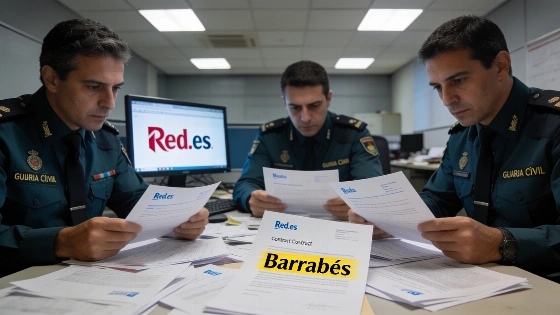
The Guardia Civil has uncovered signs of arbitrary decisions in a Red.es contract. Investigators point to preferential treatment for a consortium involving Barrabés. The case is part of a wider probe into public procurement.
The Guardia Civil has identified significant irregularities in the awarding of a public contract by Red.es, with investigators highlighting what they describe as arbitrary decision-making that favored a consortium involving businessman Juan Carlos Barrabés. The findings, detailed in a report submitted to the European Public Prosecutor’s Office in February and now in the hands of Judge Juan Carlos Barrabés, form part of a separate branch of the ongoing ‘caso Begoña Gómez’ investigation.
According to the report, the joint venture between The Valley and a company linked to Barrabés emerged as the main beneficiary of the process. The Guardia Civil’s analysis of internal emails exchanged during the bidding reveals a pattern of preferential treatment. One message, sent by a Red.es digital economy technician in January 2021, explicitly states that Barrabés’s offer was considered the preferred option, with other bids expected to be downgraded. Another email from a senior technician in February 2021 questions the criteria for preference, suggesting that other candidates might be stronger but asking for guidance on how to proceed.
Investigators note that the evaluation process did not apply the same standards to all bidders. The report points to a marked leniency toward the Barrabés consortium, especially when negative aspects of their offer were considered, while stricter criteria were used for competing bids. The Guardia Civil concludes that the assessment of proposals was not based on uniform, pre-established criteria, but rather influenced by subjective factors that shaped the outcome of the tender.
The report also highlights a shift in internal preferences during the process. Initially, both Barrabés and Everis were seen as leading candidates. However, a decisive change occurred, reportedly influenced by Luis Prieto, director of Digital Economy at Red.es, who was involved in drafting the tender documents and approving the evaluation reports. This shift further reinforced the advantage for the Barrabés consortium.
As the investigation continues, only Juan Carlos Barrabés has been formally named as a suspect in this branch of the case, facing allegations of misconduct in public office and fraud against the interests of the European Union. The case remains under judicial review, with further developments expected as authorities examine the full extent of the alleged irregularities.
Red.es is a public entity under Spain’s Ministry of Economic Affairs and Digital Transformation, responsible for promoting digital innovation and managing technology-related public contracts. The ‘caso Begoña Gómez’ has brought increased scrutiny to public procurement processes in Spain, with authorities focusing on transparency and the prevention of favoritism in the allocation of EU funds. The outcome of this investigation could have broader implications for oversight of public tenders and the accountability of officials involved in high-value contracts.