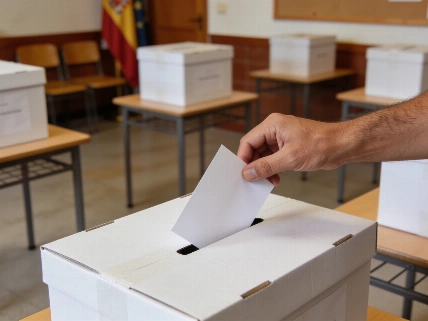
The PSOE’s federal committee backed Pedro Sánchez unanimously for the 29 November general election, then approved parliamentary lists in less than an hour. Women will head most of the party’s Congress slates for the first time.
The committee met in Fuenlabrada on 17 October, with Emiliano García-Page absent. Regional leaders had no open speaking slot. Members unanimously endorsed Prime Minister and party leader Pedro Sánchez as the PSOE’s candidate for re-election in the 29 November general election, then ratified its Congress and Senate lists. RTVE reported that the Federal Lists Commission had approved the lists unanimously the previous day.
The meeting lasted less than an hour.
No one asked to speak before the votes, according to committee sources who spoke to EFE. The federal leadership made few changes to proposals from regional organisations. The process stirred less internal controversy than the previous general election.
The approved lists contain 887 candidates: 444 women and 443 men. For the first time, women will head a majority of the PSOE’s Congress lists. The party said the composition meets the mandate adopted at its 41st Congress. EFE reported that at least 23 of the 45 members of the federal executive were included. For the Senate, women’s share of lead candidacies rose by ten percentage points compared with the 2023 election.
Page’s absence contrasted with the unity message from other regional leaders. His team told Europa Press he viewed the meeting as a formality where he had no chance to intervene. Agency sources said he wanted candidates for Congress and the Senate to attend because regional leaders were not offered an open speaking turn. Page had questioned the lack of an opportunity for leaders who wanted to address the committee, a chance that the source said is usually available at its meetings.
The party held the committee outside its usual headquarters at Ferraz in Madrid, changing the format for an event meant to launch the general-election pre-campaign. The Federal Lists Commission made only minor changes to proposals submitted by provincial organisations. In Castilla-La Mancha, two members of Sánchez’s government will head Congress lists: Housing Minister Isabel Rodríguez in Ciudad Real and Education, Vocational Training and Sports Minister Milagros Tolón in Toledo. Rebeca Torró and Pilar Bernabé, both federal figures, are standing for Congress from Valencia for the first time.
After the committee endorsed his candidacy, Sánchez addressed a rally in Fuenlabrada under the slogan “con la fuerza de la gente”. He cast the 29 November election as a choice between continuing the current course and a political rollback. Sánchez said he hoped to win with a much broader majority. He criticised calls from the right and far right to cut spending, arguing that workers and pensioners would bear the sacrifices. He also said women would be made to pay.
A separate change followed Montse Mínguez’s resignation. On 17 October, the PSOE’s federal executive commission appointed Rebeca Torró as party spokesperson. Torró kept her post as the party’s secretary for organisation. Mínguez resigned after Artículo 14 reported that her partner had a property company with more than 30 homes and had carried out several evictions. She also gave up her parliamentary seat and the lead candidacy in Lleida. Cristina Narbona will now lead Studies and Programmes, while Javier Alfonso Cendón becomes secretary general of the socialist group in Congress. Mínguez had held both roles.