The Guardia Civil arrested five Spanish and Serbian nationals accused of belonging to a group that carried out robberies targeting banks and gaming halls across eight Spanish provinces. Investigators attributed more than 50 crimes to the network, including 11 bank robberies and 15 attacks on gaming establishments, with most incidents concentrated in Almería and Albacete.
The suspects allegedly wore dark clothing, hoods and gloves to conceal their identities. To enter premises, they used tools including angle grinders, hydraulic cutters and axes, then removed safes and transported them in stolen vehicles displaying false number plates. Investigators said the group used secure locations to open safes and store money and equipment.
The investigation began after a bank robbery in March in Ontur, Albacete, in which the group allegedly stole a safe and escaped in a luxury car with €66,000. The incident helped investigators link the robbery to a network based in Murcia. Surveillance and intelligence work indicated that members had defined roles, including stealing vehicles, disabling security systems and removing safes.
Investigators said the group used properties with private parking to conceal stolen vehicles and tools, and to plan routes and logistics. The network was also accused of carrying out bursts of activity across multiple locations. These included attacks on two banks in Almería on May 29 and three gaming halls in the province on June 18.
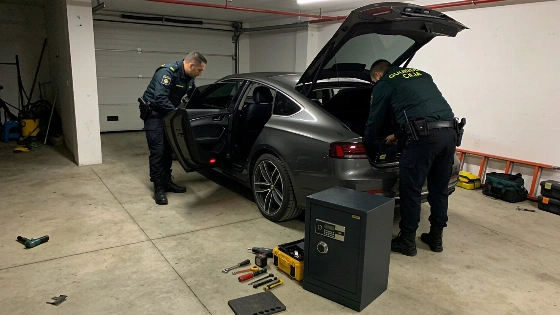
In the final phase of Operation Otello, Guardia Civil agents conducted six searches. They recovered €34,000 in cash linked to the Ontur robbery, two high-end vehicles, three forged driving licences, communications equipment, frequency jammers, balaclavas and burglary tools. The five suspects were remanded in custody by order of the court in Hellín, which is handling the case.
The investigation attributed 52 crimes to the group, including attempted robberies, vehicle and number-plate thefts, document forgery and membership of a criminal organization. The alleged offences were distributed across Albacete (12), Almería (11), Granada (7), Cuenca (5), Jaén (3), Murcia (3), Ciudad Real (2) and Valencia (2).
The case illustrates the cross-provincial investigative work required when alleged offences involve stolen vehicles, forged documents and several operating locations. Wider discussions in Valencia about urban security and the future of landmarks such as Mestalla have also raised questions about public safety and community identity, as explored in this analysis of Valencia's urban challenges.
With alleged crimes spanning eight provinces, the investigation involved coordinating evidence and operations across regional boundaries. The suspects’ alleged use of stolen vehicles and false plates, along with tools for forcing entry and removing safes, forms part of the case before the court in Hellín.