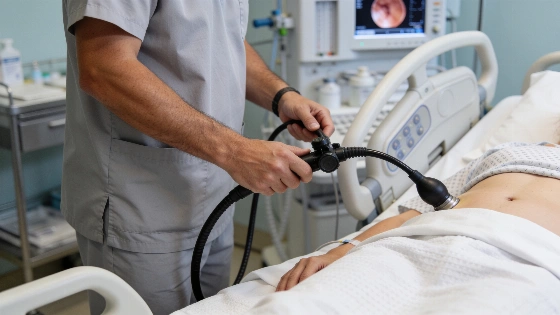
A European study followed almost 21,000 patients after high-risk polyp removal. Its findings suggest that surveillance could move from three years to five without raising cancer risk.
Surveillance colonoscopies after high-risk colorectal polyps are removed could be delayed from three years to five. The European Polyp Surveillance trial, led by Miguel Hernández University of Elche, found no higher cancer risk with the longer interval. The change could spare millions of patients repeat examinations and free healthcare capacity.
The evidence comes from three large clinical trials involving almost 21,000 people aged between 40 and 74. Patients were treated at 52 hospitals in Spain, Norway, Poland, Denmark, the Netherlands, Sweden, Austria and Portugal. In the five years after polyp removal, 99% of participants did not develop colorectal cancer.
In the interim analysis, colorectal cancer developed in 0.77% of patients assigned to a five-year interval, compared with 0.82% among those scheduled for surveillance after three years.
The findings appeared in two scientific articles in The New England Journal of Medicine. One covered the main EPoS analysis of surveillance intervals after adenoma removal. The other looked at cancer risk in patients with serrated polyps, another group of precancerous lesions.
Current clinical guidance recommends a first surveillance colonoscopy three years after a high-risk adenoma is removed. The right interval is less settled for serrated polyps because their cancer risk has not been clearly established. EPoS tested whether five-year surveillance could offer similar protection while placing less demand on patients and medical services. The PubMed abstract calls this an interim analysis of a 10-year noninferiority trial. Longer-term results may still change the picture.
The University of Aarhus said the findings could benefit thousands of patients by reducing repeat procedures and releasing capacity in healthcare systems. The potential effect is therefore not only clinical: fewer routine examinations could also ease pressure on endoscopy services facing persistent demand and limited capacity.
Colonoscopy is used to confirm abnormal screening results. It is also used to remove lesions before they become cancerous. In Spain, population screening starts with a faecal occult blood test for men and women aged 50 to 74. The test is repeated every two years. A positive result leads to a colonoscopy, during which doctors inspect the rectum and colon and can remove suspicious growths.
That system has increased the number of people diagnosed with colorectal polyps. Adenomas and serrated polyps are the most common types. Only some patients are classed as high risk after removal.
Short surveillance intervals use hospital capacity and place preparation and procedure-related demands on patients. The EPoS investigators say the new evidence allows the schedule to be reconsidered without ending surveillance. The editorial published alongside the NEJM articles makes a similar point: more intensive follow-up is not always better if it does not improve protection.
The results also question the assumption that serrated polyps always require more frequent follow-up than high-risk adenomas. Researchers found that the absolute cancer risk among patients with serrated polyps was low and similar to the risk among patients with high-risk adenomas.
Rodrigo Jover Martínez of Miguel Hernández University of Elche led the trial. He is also a researcher at the Alicante Institute for Health and Biomedical Research and head of Digestive Medicine at Dr. Balmis General University Hospital in Alicante. The study involved teams from the University of Oslo and Oslo University Hospital, as well as Amsterdam University Medical Center and hospitals across Europe. Its size and multinational design make the findings more relevant to health systems where endoscopy capacity is already under pressure.
The finding does not remove the need for surveillance. It does not make every colonoscopy unnecessary. Its practical effect is narrower: patients in the high-risk groups studied may be able to wait longer before their next examination.
International organisations responsible for clinical guidelines have received the trial results and are beginning to update their recommendations. Until that process is complete, the established three-year timetable may remain the standard in many settings.
The quality of the first colonoscopy remains decisive. The proposed longer interval depends on the initial examination finding and removing relevant lesions. That safeguard gives the study its weight. The evidence supports a less demanding schedule, not less careful prevention. It could also give healthcare systems a way to redirect colonoscopy capacity while preserving cancer protection for the patients covered by the research.