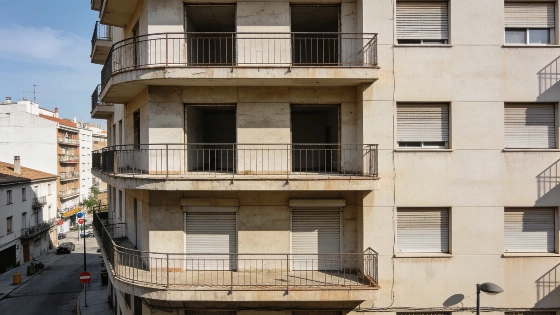
Housing has become Spain's main concern, according to the monthly CIS survey. Prices have reached a record, the country faces a structural shortage of homes, and pressure is spreading beyond its biggest cities. The poll asks who should be held responsible.
Housing has become the biggest problem facing Spaniards, according to the monthly CIS survey. Prices are still rising at double-digit rates. The basic problem is simple: demand is growing faster than the supply of homes. Official data from Spain's Ministry of Housing show that the average price of free-market housing reached €2,355 per square metre in the second quarter of 2026. That was 12.5% higher than a year earlier.
The shortage leaves fewer ways to slow the rise. It also turns responsibility into the main political question. The survey does not point to one actor. It puts the Government alongside regional and municipal administrations, investment funds, large property owners and the European Union.
The Bank of Spain estimates that Spain accumulated a housing shortage of roughly 750,000–755,000 homes from 2021. It expects the gap to increase by about another 300,000 homes by 2028.
The Government is one of the main targets of criticism. Some people blame the housing law promoted by the executive. Others say national decisions have not done enough to close the gap between demand and supply. The Bank of Spain's assessment supports the view that this is a structural problem, not a short-term fluctuation.
Responsibility also falls on the autonomous communities and municipalities. Housing conditions are not shaped by one level of government alone, according to the options presented in the survey. The scale of the increase suggests that the pressure is no longer limited to Madrid, Barcelona or the main coastal markets.
A review based on official statistics found that prices rose in all 306 Spanish municipalities with more than 25,000 inhabitants. Spain’s mechanism for designating stressed rental areas is linked, among other criteria, to housing and utility costs exceeding 30% of household income or to price growth above inflation over several years.
Investment funds and large holders are another focus of criticism. Those who point to them connect the housing problem to the role of major owners and financial investors in a market where prices are already climbing fast. The source material does not establish that they are solely responsible. It does place them among the actors being blamed.
Brussels is another possible part of the explanation. The survey asks whether the European Union should bear responsibility for failing to introduce measures that could ease the pressure on housing. That widens the dispute beyond Spain's national and local institutions. The affordability crisis is also part of a wider European trend, with rents and purchase prices rising while supply remains limited.
The answer that brings the accusations together is also the broadest one: everyone may bear part of the blame. It fits the problem described in the material. Prices are rising, supply is limited, demand is growing, and several levels of government are facing scrutiny.
The market is also failing to turn public plans into new homes. Reports citing Bank of Spain data say that 129 tenders for social housing were left without successful bidders in 2026, while 128 other planned projects were not awarded. That adds another problem to the shortage. Even when authorities try to expand public construction, the projects do not automatically become finished homes.
The poll also includes an option for people who are unsure. That matters because it is not simply asking which institution should be criticised. It is testing whether people see the housing crisis as the result of one decision or a mix of failures and pressures.
The immediate facts are stark. The CIS identifies housing as the country's biggest problem. Prices are rising at double-digit rates, especially after the pandemic, and supply is not keeping up with demand. The Ministry of Housing's second-quarter figures set a record of €2,355 per square metre for free-market homes. The Bank of Spain has also warned that real prices are accelerating at levels comparable with 2005, a period linked to pre-crisis overheating.
Political pressure has grown with the market indicators. AFP reported that Prime Minister Pedro Sánchez called the housing crisis a "tragedy" after an elderly woman was evicted. The issue has moved beyond economics and into a highly sensitive social and political debate.
Assigning all the blame to one institution would not fit the evidence presented. The housing problem is being treated as a shared political and market failure. The Government, autonomous communities, municipalities, large owners, investment funds and the European Union are all under scrutiny. The survey's most credible answer is therefore the collective one: no single culprit explains the situation on its own.