How to Legally Reduce Your Gas Bill in Spain Without Investment or Renovation. Many families in Spain have been overpaying for gas for years by not changing their tariff or reviewing their terms. Meanwhile, switching to a regulated tariff plan and making simple adjustments to heating temperature can save up to 20%—all without extra costs or complications.
Gas bills in Spain are often paid out of habit—without analyzing whether the terms are favorable. But this is exactly where the root of regular overpayments lies: most households do not review their tariffs for years, do not compare offers, and do not consider that the market has changed long ago.
There are two main schemes in the country: the regulated market (with the TUR tariff, set by the government) and the free market, where terms are dictated by the companies themselves. The difference is far from trivial: according to estimates, switching tariffs can reduce your annual bill by 10–20%.
Why bills end up higher
Gas is one of the most expensive utilities, but the supply contract is often ignored after signing. As a result, many pay under outdated conditions that do not reflect their actual consumption. The difference between an optimal and a disadvantageous scheme can reach up to 20% a year.
Regulated and free market: what you need to know
The regulated segment has only one model—Tarifa de Último Recurso (TUR), offered by specialized companies at prices approved by the government every quarter. In the free market, each company sets its own tariffs and terms, so it is important to read the contract carefully: hidden fees and surcharges are common.
How TUR works and who can switch
The TUR tariff is divided into categories based on annual consumption: TUR 1 — up to 5,000 kWh, TUR 2 — from 5,001 to 15,000 kWh. The higher the category, the greater the fixed component, but the lower the cost per kWh. Since January 1, 2026, the TUR tariff has decreased by an average of 8.7% compared to the previous quarter, due to cheaper raw materials. However, the actual savings for consumers amounted to 3.7–4.8%, depending on the volume of consumption.
Switching to TUR: quick and free
You can change your tariff without investments or renovations: just contact the reference company in your region. The process is free and takes up to 21 days if there are no technical obstacles. Beforehand, you should check which market you are currently on (the information is in your bill), find out your annual consumption, and compare offers using the official CNMC calculator — its QR code is usually printed on your receipt.
If TUR turns out to be more cost-effective, simply submit an application to switch. This step can yield significant savings as early as next month. A detailed guide on changing tariffs and analyzing conditions is also available in other materials — for example, in an article about how a large Spanish family optimizes household expenses (read more).
Temperature is another way to save
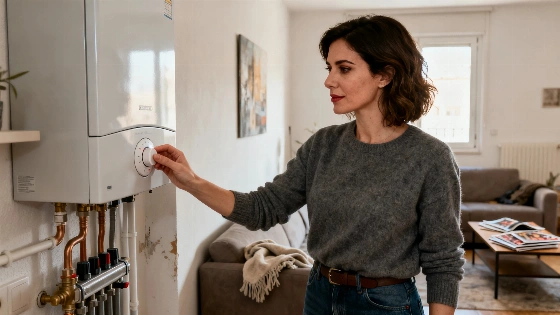
After changing the tariff, it's worth paying attention to your heating settings. Every extra degree increases gas consumption by 7–8%. The optimal range for living spaces is 19–21°C. Since heating accounts for up to 70% of total gas use in a typical apartment, lowering the temperature by just 1 degree can save up to 8% on this part of the bill.
Combined approach
The maximum effect is achieved by combining two steps: switching to the optimal tariff and adjusting the temperature. Together, they can reduce your annual bill by 15–25% without investments or complex changes. In homes with poor insulation, the effect can be even more significant.
For those looking to save even more, consider additional measures such as insulating windows, regular boiler maintenance, and analyzing other utility services. But even simply changing your tariff and adjusting your heating already delivers noticeable results—without renovation or additional costs.