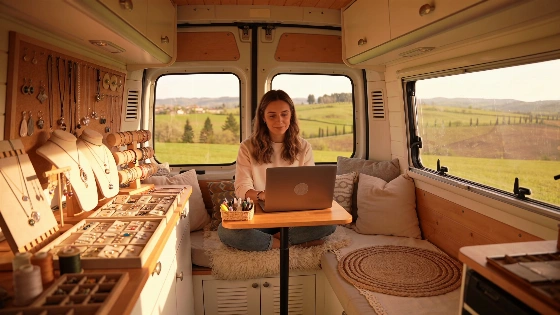
Lorena did not want to trade her time and freedom for a conventional career. Instead, she found a way to combine work with her lifestyle, converting a camper van into a home and workspace that includes an artisan workshop. For her, this is a deliberate choice to live and work without a fixed address, not a temporary adventure.
Her van is more than a vehicle: it underpins three distinct sources of income. Lorena offers online consultations in natural medicine, connecting with clients wherever she has a stable internet connection. She also works as a brand ambassador for a company specializing in natural supplements and cosmetics. The role lets her grow her network and income by inviting others to join the project. Her third venture is a handcrafted jewelry brand, a creative pursuit she describes as both a passion and a source of peace.
Three Streams of Income
Each of Lorena's activities is suited to life on the move. Her online therapy sessions require only a laptop and internet access. The brand partnership offers flexibility and potential for growth; her jewelry business lets her create and sell unique pieces wherever she parks her van. Together, the work has helped her build a routine that adapts to her travels and personal projects.
Lorena shares her journey openly on social media, but does not disclose specific earnings or a financial breakdown of each business. Her experience is a personal example of income diversification, not a guaranteed formula for financial success.
The Real Costs of Van Life
Choosing van life brings impressive upfront costs. Information from a 2026 industry guide, converting a van into a livable space can cost anywhere from €3,000 to €30,000. The final price depends on the van's size, the materials and equipment chosen, and whether professionals do the work. The van itself is an additional expense: a used camper can cost €20,000 to €45,000, while a new model may exceed €50,000. Age, mileage and mechanical condition all affect those figures.
Buying used also brings transaction costs beyond the advertised price. In Spain, the buyer generally pays the Impuesto de Transmisiones Patrimoniales (ITP), whose rate varies by autonomous community. The taxable value may be assessed using annual reference tables that account for the vehicle’s make, model and age. Administrative fees apply to a motorhome transfer as well, so the purchase budget must cover more than the vehicle itself.
Legal requirements add another layer of complexity. Any modifications must be approved at an authorized ITV station to be officially registered, as noted by the Dirección General de Tráfico. Where a van can stay overnight is a separate question: Spanish traffic guidance distinguishes parking from camping. A vehicle generally remains parked if it stays within its road footprint and does not set out camping equipment, such as an awning, table or chairs, or use stabilizing legs or discharge wastewater. Such camping-related activity may fall under regional and municipal rules, so a legally parked vehicle is not automatically permitted to serve as an overnight campsite. Guidance on the DGT structure sums up the distinction as “Estacionar no es acampar.”
The rules also vary by location. Regional tourism legislation may recognize motorhome accommodation, while municipalities decide where facilities are located and which local parking conditions apply. Signs and local ordinances matter alongside regional rules. On 22 October 2026, the Comunidad de Madrid approved a tourism-law reform recognizing areas for the reception and overnight stay of motorhomes, camper vehicles and similar vehicles. The reform also recognizes hostels, expands travelers’ rights and increases tourism businesses’ obligations. Local siting and operating conditions still matter in practice.
Ongoing Expenses and Daily Realities
Living on wheels eliminates rent, but monthly expenses remain. Fuel and food are part of the budget, as are insurance, maintenance and repairs. Internet, gas, water and overnight parking add further costs. Estimates suggest monthly spending can range from €500 to €1,200 per person, depending on travel distance and whether free or paid parking areas are used. A breakdown can disrupt transportation and housing at the same time.
Designated motorhome areas can offer more than a place to park. Facilities may include firm, level pitches and electrical connections, along with sanitary services, reception arrangements and points for wastewater disposal. For someone using a van as both home and workplace, access to electricity and water matters, as do sanitation and a reliable connection. These services show why mobile living depends on suitable infrastructure and local authorization as well as the vehicle.
Lorena's story shows how digital and creative professions can adapt to a mobile lifestyle, provided there is careful financial planning, reliable internet and the ability to manage multiple projects. Her approach is not universal, but it reflects growing interest in alternative ways of living and working.
For those considering a similar path, experts recommend researching legal requirements and budgeting for both initial and ongoing costs. They also advise making sure income streams are truly portable. The appeal of freedom on the road is real, as are the practical challenges that come with it.