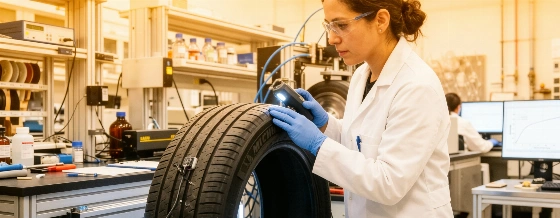
American Scientists Unveil the Secret of Tire Durability After a Century of Search. A team of researchers from the United States has, for the first time, explained why the addition of carbon black makes tire and machinery rubber nearly indestructible. Their discovery is changing the approach to creating durable and cost-effective materials.
For a hundred years, tire and industrial rubber manufacturers have known: if you add a special carbon black to the material, it becomes much stronger and more durable. But no one could explain exactly why this happens—not engineers, chemists, or physicists. Now the mystery is solved: a team from the University of South Florida, using supercomputers, has for the first time modeled what happens inside rubber at the molecular level.
The research, published in the Proceedings of the National Academy of Sciences, marks a breakthrough for the entire industry. As noted by Auto Bild, scientists led by Professor David Simmons conducted one and a half thousand complex simulations to observe how hundreds of thousands of atoms in carbon black-filled rubber behave under stress. Such computational volume would have been impossible just a decade ago.
Three effects instead of one
The main conclusion: rubber toughness is not the result of a single process but a complex combination of three phenomena at the nanoscale. First, carbon black particles form a dense network that binds polymer chains together. Second, strong chemical bonds develop between the carbon black and rubber molecules—in essence, a molecular adhesive. Third, carbon black fills microscopic voids, preventing polymers from breaking even under extreme loads.
A key role is played by the so-called Poisson's ratio—a physical characteristic that determines how a material deforms under pressure. It turned out that the combination of the soot mesh, chemical 'glue,' and the space-filling effect makes rubber almost impervious to tearing and abrasion.
The end of the 'trial and error' era
Until this discovery, tire and industrial product manufacturers were forced to work blindly: selecting types of soot and proportions through trial and error, spending years and millions on testing. Now that the physics of the process is understood, materials can be designed with specific properties—for example, creating tires that last longer, grip wet roads better, and reduce fuel consumption or increase the range of electric vehicles.
According to experts, this discovery will make it possible to produce not only more efficient tires, but also ultra-reliable seals, valves, and hoses for industry and medicine. Technologies that developed by touch for decades now have a scientific foundation.
For reference: soot is a special form of carbon obtained by burning hydrocarbons. It is used not only in rubber, but also in paints, plastics, and electronics. In the automotive industry, it became indispensable precisely due to its unique combination of strength and elasticity, which has now been explained by science for the first time.