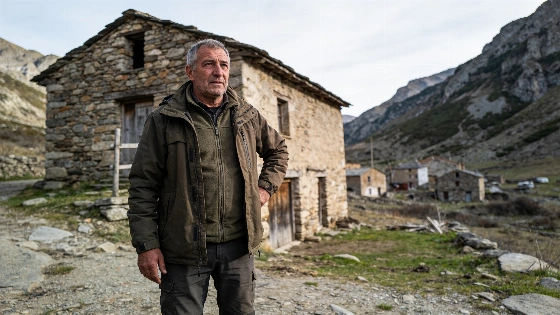
Tomàs Ballesté, 64, has spent twelve years in Solanell, a remote Pyrenean hamlet, living on a €480 monthly subsidy. He describes how he manages daily life with minimal expenses and what it takes to remain in a place where few others stay year-round.
At 64, Tomàs Ballesté has made Solanell, a tiny settlement in the Pyrenees, his home for over a decade. After losing vision in one eye and his job at 52, he left Girona, where he had stayed near his daughter, and moved to this nearly deserted village. His decision was sparked by his brother, who introduced him to a project aimed at reviving Solanell, echoing similar efforts in other abandoned Spanish villages.
Ballesté arrived with little certainty but soon became involved in restoring old houses and picking up occasional work, including a stint at the local archive. He taught himself construction skills, relying on advice from others and online resources. Over time, he adapted to a lifestyle defined by austerity, supported by a €480 monthly subsidy. He openly states, “I have a subsidy of 480 euros and with that you have to survive,” highlighting that the absence of shops and bars makes it easier to keep spending in check.
While some reports have called him Solanell’s only resident, official data from Idescat lists five inhabitants as of January 2025—four men and one woman. It remains unclear how many live there year-round, but the narrative of a single permanent resident is not officially confirmed. The village’s population has plummeted from 107 in 1857 to just a handful today, despite recent rehabilitation projects bringing some activity back to the area.
Life on a Minimal Subsidy
Ballesté refers to his income as a “contributory subsidy,” but the exact nature of the benefit is not publicly documented. The €480 figure matches the 2026 amount for Spain’s unemployment subsidy for those over 52, set at 80% of the IPREM, though other aid types can also reach this amount. Eligibility for the over-52 subsidy requires more than just age: applicants must prove unemployment, sufficient contributions, and lack of other income, among other criteria. The benefit can last until retirement age, with the SEPE contributing to future pension entitlements. However, there is no public record confirming which specific aid Ballesté receives.
Solanell’s Demographic Reality
The idea of Solanell as a ghost village is only partly accurate. According to the latest Idescat data, five people are officially registered, though the number of continuous residents is uncertain. The local council’s records show a dramatic decline over the past century, with the population dropping from over a hundred to single digits. Despite this, the area is no longer entirely abandoned, thanks to ongoing restoration efforts.
Rural Recovery and Its Limits
Solanell’s story fits into a broader trend of rural revival in Spain. The Ministry for the Ecological Transition and Demographic Challenge reports that municipalities with fewer than 5,000 residents gained over 22,000 people in 2024, and most small towns now have a positive migration balance. Yet, challenges remain: stable jobs, housing, healthcare, and education are still hard to secure in many rural areas. The government’s 2026 National Strategy for Territorial Equity prioritizes these issues, but as Ballesté notes, “you have to come to live, not to escape.” His experience shows that a frugal lifestyle is possible, but only when basic needs—housing, income, and access to services—are met.
For those considering a similar move, Ballesté’s case is a reminder that rural life demands more than just a willingness to cut costs. It requires resilience, adaptability, and a realistic view of what small villages can offer. The legal and financial details of subsidies can be complex, as seen in other cases where courts have clarified entitlements for retirees, such as a recent decision on fuel bonuses for pensioners reported here. Ultimately, Solanell’s slow revival is a testament to both the possibilities and the limits of rural renewal in Spain.