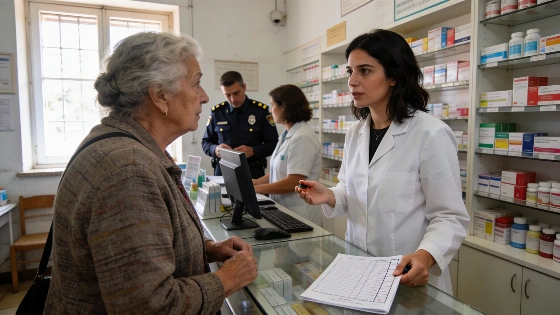
Pilot project launched in rural Spain with pharmacists and police joining forces. In two regions of Spain, pharmacies have started collaborating with police to help prevent the disappearances of elderly people and minors. The new protocol is already in effect in Zamora and Murcia. Authorities are counting on rapid alerts about potential risks.
A new protocol has been launched in Spain, involving pharmacies in the early response system for missing elderly people and minors. The project is being implemented in Zamora and Murcia, where pharmacists now work directly with the police and the Civil Guard. The initiative aims to use pharmacies’ daily contact with residents to identify early signs of disorientation or risk of disappearance.
The idea originated after Teresa Ares, a rural pharmacist from Mombei, suggested to her colleagues and law enforcement to pay attention to vulnerable patients who might suddenly go missing. In small communities, pharmacies often remain the only place where changes in the behavior of elderly people are noticed. Now, if a pharmacist observes warning signs—such as someone stopping their regular medication visits or looking unkempt—they can quickly contact the assigned police or Civil Guard representative.
Under the protocol, pharmacists receive training, are given the contact information of responsible police officers, and use special checklists to assess risk. If certain criteria are met, the information is passed on to law enforcement. Pharmacies also display posters with missing persons alerts and use the internal FarmaHelp network to share information about missing people in neighboring provinces.
The first training sessions for pharmacists have already taken place in Murcia and Zamora, where real cases of disappearances were discussed and actions under the new protocol were practiced. In Murcia, where 580 missing person reports were registered last year, of which 407 concerned minors, the project attracted significant interest. In Zamora, where the population is aging, 35 disappearances were recorded, most involving adults.
Authorities are considering the possibility of introducing additional technologies, such as geolocation devices that can be attached to the clothing of elderly people. Particular attention is paid to the first hours after a disappearance, as it is during this period that the chances of a successful search are greatest. In the event of a disappearance, pharmacies can quickly disseminate information among colleagues and post alerts in prominent places.
According to the National Center for Missing Persons, there were 6,874 active missing persons cases in Spain at the end of 2025, with 7% involving elderly people and 40% minors. Authorities believe that involving pharmacies will allow for a quicker response to alarming situations and reduce the number of tragic outcomes. Similar measures to digitize procedures are already being implemented in other sectors, for example, starting in 2026, sick leave notifications in Spain will become fully electronic.
For reference: there are more than 22,000 pharmacies in Spain employing over 55,000 specialists. In rural areas, pharmacies often serve not only a medical but also a social function, remaining the link between residents and emergency services.