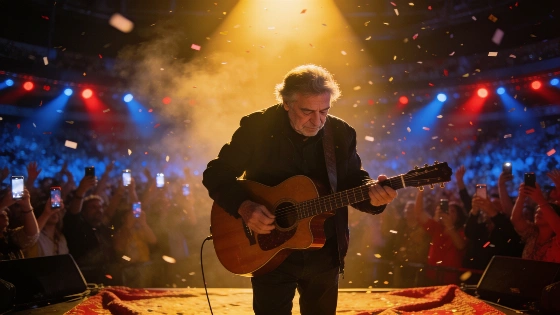
Joaquín Sabina has officially retired after a sold-out farewell concert in Madrid. The singer-songwriter reflects on fame, lost nights, and the end of an era. His last live album marks a turning point for Spanish music.
Joaquín Sabina, one of Spain’s most influential singer-songwriters, has concluded his decades-long stage career with a final concert at Madrid’s Movistar Arena. The event, held on November 30, 2025, marked the end of a major tour spanning Europe and the Americas, and closed a chapter that saw Sabina’s songs become intergenerational anthems. The release of a live album from this last performance now stands as a milestone in Spanish music.
With his retirement, Sabina steps away from the relentless pace of touring and public commitments. For the first time in years, he faces a life without professional obligations, opening space for personal freedom and reconnection with people and routines long sidelined by his career. His journey, from exile in London during the Franco era—where he played in restaurants and bars—to filling stadiums across continents, has been marked by both artistic triumph and personal excess.
In a recent interview with EFE, Sabina acknowledged the intensity of his past, admitting regret over time lost in nightlife rather than writing. He described his generation as one that flirted with risk, referencing the prevalence of heroin among peers, though clarifying he never tried it himself. Many, he noted, did not survive those years. Despite the absence of nostalgia, Sabina emphasized the power of memory, recalling fleeting moments of happiness that remain unforgettable.
Fame, Sabina explained, has often been a double-edged sword. While he once found inspiration in the solitude of late-night bars, he now feels distanced from those spaces. The singer recounted how, after his final show, dozens of fans waited outside his home—an experience at odds with his preference for anonymity. This tension between public recognition and personal privacy echoes challenges faced by other Spanish cultural figures, such as Boris Izaguirre, whose own journey through adversity and public life was recently explored in a feature on overcoming trauma and resilience.
Sabina’s withdrawal from the stage signals more than the end of a career; it highlights the shifting landscape of Spanish music and the pressures that come with enduring fame. His reflections on lost time, the burdens of celebrity, and the search for creative space resonate with many artists navigating similar paths. As Sabina embraces a quieter life, his legacy remains deeply woven into Spain’s cultural fabric, with his songs continuing to inspire new generations. The release of his final concert album offers fans a lasting record of a unique artistic voice, while also prompting broader conversations about the cost of public life and the value of personal freedom.
For context, Joaquín Sabina was born in Úbeda, Jaén, in 1949. He became a central figure in Spain’s transition-era music scene, known for his poetic lyrics and candid storytelling. Over the years, Sabina’s work has been recognized with numerous awards, and his influence extends beyond music into literature and social commentary. His retirement marks the close of an era, but his impact on Spanish culture is set to endure.