Juan Manuel Moreno took office as president of the Junta de Andalucía this morning, beginning his third term at the helm of the region. The ceremony, held at the Palacio de San Telmo before 300 guests, came just days after Moreno won his investiture in Parliament with decisive backing from Vox. For the first time since the Franco era, the far right will hold a vice presidency and participate directly in the Andalusian government. The shift followed the 17 May 2026 election, in which the Partido Popular won 53 seats in the 109-member Parlamento de Andalucía, two short of the 55-seat absolute-majority threshold, while Vox secured 15.
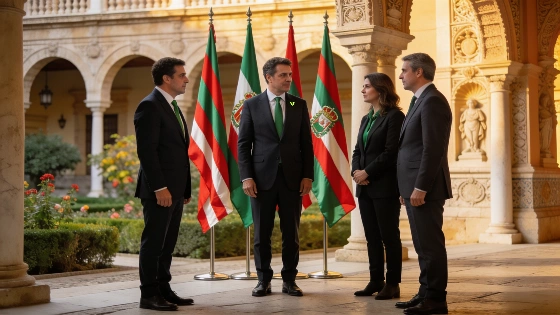
Vox's 15 votes made the investiture possible, following a coalition agreement in which Moreno accepted basic elements of the party's policy agenda. The pact brought Vox into the executive instead of leaving it as an external parliamentary ally, forming a governing bloc with 68 seats. The event was more subdued than four years ago, when Moreno's inauguration took place outside the palace in a larger, more public ceremony that emphasized the significance of his leadership. This year, proceedings moved to the palace's inner gardens, a more discreet setting for the political shift.
Moreno's Partido Popular lost the absolute majority it held in the previous legislature, forcing the regional leader to negotiate with a party he had previously kept at a distance. The agreement established Andalusia's first PP-Vox coalition government and gave Vox direct responsibility for implementing policy. Its reported programme also adopts Vox's “national priority” concept in allocating certain public aid, including subsidies and benefits. Moreno had previously dismissed the phrase as mere rhetoric. Its inclusion in the coalition agreement marks a shift in the government's policy language and has drawn criticism.
Attention now turns to the composition of the new cabinet. Manuel Gavira, Vox's regional leader, will serve as the government's second vice president, overseeing Tourism and Deregulation, as well as Justice and Local Administration. The full list of ministers has yet to be announced, but Moreno has said the expanded leadership is intended to balance power within the coalition. The number of ministries is expected to remain at thirteen. The development echoes wider concerns about the far right's growing influence in Spanish politics. Junts raised similar concerns at the national level when it called for a change in PSOE leadership to prevent such a shift, as discussed in this related report.
The coalition's first major institutional test will be the 2027 regional budget. Its identified priorities include health and education, along with dependency support and housing. The PP-Vox bloc's 68 seats give it a working majority in the regional chamber. The partnership has already shaped parliamentary oversight: PP and Vox jointly rejected a proposal to establish a commission investigating failures in cancer screening, a crisis acknowledged by the Junta. Opposition representative Rafael Segovia argued that Vox could help clarify what had happened. The joint vote showed the coalition coordinating beyond the investiture.
Andalusia, Spain's most populous region, has long carried weight in national politics. Vox's entry into the regional government opens a new chapter, reflecting a wider European trend as far-right parties gain ground in coalition arrangements. The Palacio de San Telmo, a baroque landmark in Seville, has been the seat of the Andalusian government since 1989 and often hosts major political events. As the new administration takes shape, the test will be how the coalition handles policy differences and public expectations, and how its agreements shape budgets and government decisions.