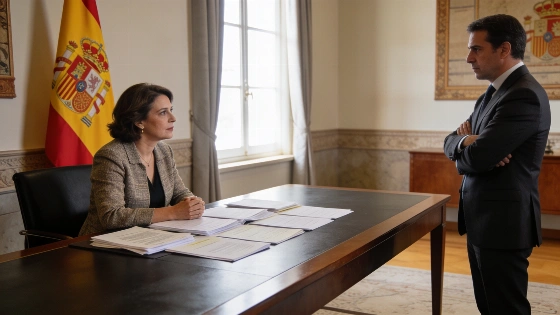
Spain’s top judicial official rebuffed Interior Minister Marlaska after he protested a judge’s order barring police from briefing superiors on Ceuta’s border crisis. The dispute exposes deep institutional fault lines over control and transparency.
Spain’s top judicial officials have pushed back against Interior Minister Fernando Grande-Marlaska after he challenged a judge’s authority during the Ceuta border crisis. The dispute began when Marlaska formally objected to a decision by María Tardón, a magistrate of the Audiencia Nacional, who ordered police not to share details of an ongoing investigation with their superiors or political leaders.
The case centers on a confidential police report from Ceuta, which points to Moroccan gendarmerie involvement in the mass border crossing on July 30 and 31. Judge Tardón instructed police to keep the findings within judicial channels, blocking the Interior Ministry from receiving updates during a declared national security emergency. According to EFE, the police report described the events as "planned" rather than spontaneous, adding fuel to the debate over how the crisis unfolded.
Media summaries of the police report estimate that between 72,000 and 80,000 people were involved in the Ceuta crossing, with about 90% leaving the city within hours.
Marlaska, himself a former Audiencia Nacional judge, sent a letter to Isabel Perelló, president of the Consejo General del Poder Judicial (CGPJ), expressing his frustration. He argued that, given the seriousness of the crisis and its classification under Spain’s National Security Law, the government needed real-time information to manage the situation and fulfill its constitutional duties. Marlaska insisted that judicial independence should not prevent the executive from receiving critical data needed for decision-making. Reports from Democrata and EFE note that Marlaska specifically raised concerns that the police investigative group could not brief leadership because of Judge Tardón’s restrictions.
Perelló responded quickly and directly. She reminded Marlaska that the law bars any interference, censorship, or correction of judicial actions by outside authorities, citing articles of the Ley Orgánica del Poder Judicial. Perelló also pointed out that the Spanish Constitution requires all citizens—and especially the police—to cooperate with judicial investigations, regardless of their administrative rank or political oversight. In her statement on September 3, Perelló called for full respect for Judge Tardón’s work and reaffirmed the legal limits on the CGPJ’s ability to review or alter judicial decisions.
Perelló closed her letter by acknowledging the seriousness of the migration crisis but stood behind Judge Tardón’s actions, describing them as a legitimate use of constitutional powers. Her message was clear: judicial independence is not negotiable, even in the face of national emergencies.
Several media outlets reported that the police document referenced active involvement by Moroccan security forces during the July 30–31 events, but the director of Spain’s National Police publicly denied that any official report attributed planning or execution of the crossing to Moroccan authorities.
Spain English
This is not the first time Marlaska has clashed with the judiciary over police conduct. In June, he criticized another magistrate, Peinado, for questioning the actions of National Police officers assigned to the security detail of Begoña Gómez, the prime minister’s wife, during a separate high-profile case. Government pushback against judicial decisions has become more visible, as highlighted in a previous investigation.
Spanish law is clear: when acting as judicial police, officers answer only to judges and courts, not to political superiors. The Ley de Enjuiciamiento Criminal and the Ley Orgánica de Fuerzas y Cuerpos de Seguridad reinforce this separation to keep investigations free from political influence. The Ceuta episode highlights the tension that arises when executive urgency meets judicial autonomy, especially in matters of national security and border control.
The standoff shows a judiciary unwilling to give ground, even under political pressure. The government’s demand for operational intelligence during a crisis is understandable, but it risks undermining the checks and balances that prevent abuse of power. Perelló’s firm response signals that Spain’s courts will not accept interference, regardless of the stakes. In a climate where institutional boundaries are often tested, this episode is a reminder that the rule of law is a principle Spain’s judiciary intends to defend—even when challenged by its own former colleagues.