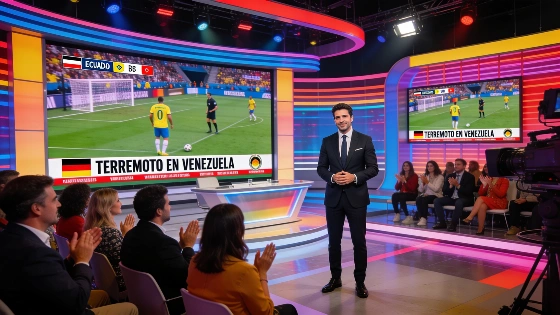
La 1 claimed Spain’s highest television audience share this Thursday, reaching 15.7% and beating competitors across all major time slots. Its lead rested on the live Ecuador-Germany World Cup match, the day’s most-watched program, and extensive coverage of the earthquakes in Venezuela.
The Ecuador-Germany clash, part of the third round in Group E of the 2026 World Cup, drew a 24.7% share and averaged 2.6 million viewers. More than 6.7 million tuned in at some point. Ecuador’s 2-1 victory over Julian Nagelsmann’s side led its time slot and set the pace for the day’s television audience. The match’s impact on Spanish viewership echoes interest in other major World Cup fixtures, including the recent high-stakes encounter between Portugal and Uzbekistan, detailed in this related report.
Entertainment also boosted La 1’s performance. The third episode of ‘El perro andaluz by Manu Sánchez’ held its lead in the late-night slot, attracting 13.7% of the audience and averaging 711,000 viewers. The show drew viewers across age groups, with particularly strong numbers among those aged 13 to 24 (21.4%) and 25 to 44 (18%). Regional audiences in Andalucía (16.9%), Castilla y León (16.4%) and Madrid (14.8%) contributed to its success. The program’s guests, including Pastora Soler, Xavier Sardà and María Galiana, helped it reach more than 3 million unique viewers.
News programming also drove La 1’s Thursday results. ‘Telediario Matinal’ led its slot with a 24.8% share, reporting live on the Venezuelan earthquakes, which measured 7.5 and 7.2. The two shocks struck northern Venezuela on June 24 in rapid succession: the first, magnitude 7.2, near San Felipe in Yaracuy, followed about 30 to 39 seconds later by a magnitude 7.5 quake offshore from La Guaira near Catia La Mar. The U.S. National Weather Service placed the larger earthquake at 18:05 local time, at a depth of about 10 kilometres, and said it posed no destructive tsunami threat. ‘La hora de La 1’ continued the coverage, drawing a 23.7% share and an average of 425,000 viewers, with more than 1.6 million unique contacts. The midday ‘Telediario 1’ reached 1.68 million viewers (18.2% share), while the evening ‘Telediario 2’ attracted 1.49 million (17% share). A special edition of ‘La noche en 24h’ on La 2 and Canal 24 horas, focused on Venezuela, registered a 4.3% share and more than 2.7 million unique viewers.
The earthquakes caused severe, uneven damage across Venezuela’s north-basic region. The strongest impacts were reported in La Guaira, including Catia La Mar, Caraballeda, Macuto and Maiquetía, as well as parts of Caracas and Yaracuy. A later account by Venezuela’s Academy of Physical, Mathematical and Natural Sciences described impressive damage in Caracas neighbourhoods including San Bernardino and Los Palos Grandes, alongside deaths, displacement and interruptions to impressive services. Researchers also reconstructed ground motion in Caraballeda from surveillance-camera footage, analyzing the movement of a traffic delineator and a light pole to estimate a peak ground velocity of 202 centimetres per second. Reports on the study cited preliminary estimates of about 1,300 collapsed buildings in La Guaira and damage to more than 26,290 structures nationwide.
The seismic sequence continued long after the initial doublet. Funvisis, Venezuela’s seismic-monitoring institution, reportedly recorded 90 earthquakes during one week in October and more than 2,200 aftershocks since the June events. That continuing activity kept the story in the news beyond the initial emergency coverage.
Daytime and afternoon programming also strengthened La 1’s showing. ‘Mañaneros 360’ approached half a million viewers with a 15% share, while ‘Directo al grano’ led its slot with 11.8% and nearly 1 million average viewers. Afternoon series such as ‘La Promesa’ (13.5% share, 1.4 million unique viewers), ‘Valle Salvaje’ (11.5%, 1.5 million contacts) and ‘Malas Lenguas’ (10.4%, 1.9 million unique viewers) kept their leads, especially among viewers aged 45 to 60. On La 2, Jesús Cintora’s program doubled the channel’s daily average, reaching a 7.3% share and 530,000 viewers.
Other impressive results came from ‘Aquí la tierra’ with Jacob Petrus, which posted a 12.1% share and averaged 925,000 viewers, and La 2’s quiz shows. ‘Saber y ganar’ led with 599,000 viewers (6.6% share), followed by ‘Cifras y letras’ with 541,000 (4.9%) and ‘Trivial Pursuit’ with 427,000 (4.6%).
Spain’s television market in 2026 remains highly competitive, with major sporting events and breaking news driving audience spikes. Public broadcasters like La 1 continue to draw on live sports and popular entertainment, alongside timely news, to secure leading positions in national ratings. Strong results for news and entertainment formats point to demand for varied programming, especially during international crises or major sporting tournaments.