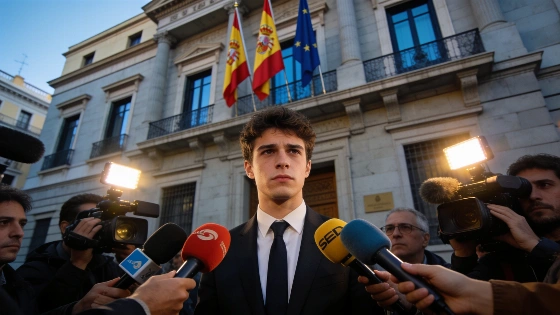
Francisco Nicolás, known as 'El Pequeño Nicolás', avoids prison after a Madrid court suspended his sentence. He must pay a €1,800 fine and remain crime-free for four years. The case highlights ongoing scrutiny of high-profile legal decisions.
The Provincial Court of Madrid has decided to suspend the prison sentence of Francisco Nicolás Gómez Iglesias, widely recognized as 'El Pequeño Nicolás', following a series of convictions for document forgery and impersonation of senior officials. This move means that, despite facing more than 12 years behind bars, he will not serve time in prison, provided he meets strict conditions set by the court.
According to the court order, which was reviewed by EL PAÍS, the suspension is contingent on Nicolás not committing any criminal offenses over the next four years. Additionally, he is required to pay a daily fine of six euros for ten months, totaling €1,800. This decision comes after a lengthy legal process in which Nicolás was found guilty of orchestrating a fake royal entourage and using forged documents to pose as a government representative.
The Supreme Court had previously confirmed his conviction on March 26, upholding charges of inciting the disclosure and revelation of secrets, as well as active bribery. However, the Supreme Court reduced the original sentence handed down by the Madrid court, which had imposed four years and three months in prison. The reduction was granted after the defense successfully argued for mitigating circumstances, resulting in a new sentence of seven months and 15 days for the secrets offense and one year and six months for bribery. Since neither sentence exceeded two years individually, the legal framework allowed for the possibility of suspending his prison entry—a step now formalized by the Madrid court.
This outcome has reignited public discussion about the consistency of Spain's judicial system, especially in high-profile cases involving public figures. The case of 'El Pequeño Nicolás' stands out for its unusual combination of media attention, legal complexity, and the relatively lenient final outcome. For comparison, other recent court decisions in Spain have drawn attention for their severity, such as the sentencing of a couple in Alicante to over 13 years in prison for a violent crime, as detailed in this report on a notorious Alicante case.
Spain's legal system allows for the suspension of prison sentences under certain conditions, particularly when individual sentences do not surpass two years and the convicted person has no significant criminal record. The court's decision in the Nicolás case reflects this principle, but also highlights the ongoing debate about proportionality and public trust in judicial outcomes. As the case continues to attract attention, it serves as a reminder of the complexities involved in balancing legal precedent, individual circumstances, and societal expectations in Spain's courts.