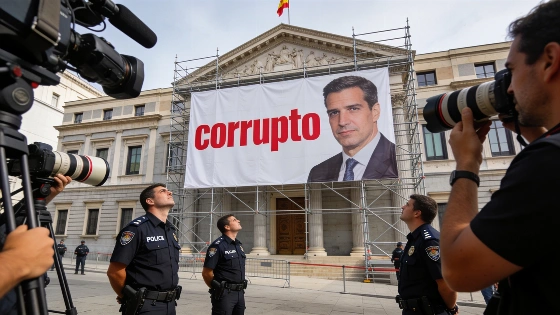
A Madrid court has confirmed the closure of the case against Hazte Oír for a banner calling Pedro Sánchez 'corrupt'. Judges ruled it was political criticism, not an insult. The decision highlights the limits of free speech in Spanish politics.
The Audiencia Provincial de Madrid has confirmed the dismissal of the case against Hazte Oír, the ultraconservative association that displayed a large banner labeling Prime Minister Pedro Sánchez as “corrupt” near the Spanish Congress. The court found that, while the term is a serious accusation, its use in this context was protected as political criticism under freedom of expression. The decision comes after months of legal dispute and public attention, underscoring the ongoing tension between political speech and personal honor in Spain.
The incident occurred on May 19, 2025, when Hazte Oír hung a massive banner on scaffolding directly facing the Congress of Deputies. The banner featured Sánchez’s image alongside the word “corrupto” and references to several ongoing judicial cases, including “Caso Begoña”, “Caso Ábalos/Koldo”, “Caso PSOE”, “Caso Hermano”, “Caso Fiscal General de Pedro Sanchez”, and “Caso Hidrocarburos”. The PSOE immediately filed a complaint, prompting a judge to order the banner’s removal as a precautionary measure. In the days that followed, similar messages appeared on bridges and walkways across Madrid, and a truck circulated the city displaying the same imagery. On May 28, 2025, Hazte Oír also shared footage of the phrase “Sánchez corrupto” projected onto the Congress facade.
According to the court’s ruling, the use of the word “corrupto” could be seen as a grave insult if considered in isolation. However, the judges emphasized that, given its association with ongoing legal proceedings involving Sánchez’s circle, the intent was not to insult but to express political criticism. The court further noted there was no incitement to violence or hate speech in the campaign. The ruling highlighted that public figures must tolerate a higher degree of scrutiny and criticism, especially when the issues raised are of general interest. The case had already been dismissed in February 2026 by Judge María Dolores Baeza, but the PSOE and the public prosecutor appealed, arguing that the actions went beyond legitimate political criticism and threatened political coexistence. The prosecutor also pointed out that a police report was still pending at the time of the initial dismissal.
The court’s decision has reignited debate over the boundaries of free speech and political discourse in Spain. The judges made clear that, in the context of political controversy, freedom of expression should generally take precedence over the right to honor. This principle has been at the center of several recent legal battles involving politicians and activists. For example, the issue of privacy and the exposure of personal data in Spanish politics was recently highlighted when confidential information about José Luis Rodríguez Zapatero was leaked, sparking renewed discussion about legal protections and the limits of public scrutiny, as detailed in this related report.
Spain’s legal framework provides robust protections for freedom of expression, particularly in matters of public interest and political debate. However, the line between criticism and defamation remains a frequent source of litigation. The Audiencia Provincial’s ruling in the Hazte Oír case reinforces the judiciary’s tendency to favor open political discourse, even when it involves harsh language or controversial accusations. This approach reflects broader European standards, where courts often prioritize the public’s right to debate political matters over the reputational concerns of public officials. The outcome of this case may influence future disputes involving political messaging and the limits of acceptable speech in Spain’s increasingly polarized environment.