Madrid’s city council has approved land deals benefiting Real Madrid and Atlético. The clubs gain access to public plots for private projects, sparking criticism over favoritism and the use of public assets. The financial impact is substantial.
Real Madrid and Atlético de Madrid have secured some of the most profitable urban development deals in recent memory, following decisions by Madrid’s city council to hand over large public land parcels for private use. These agreements, approved by Mayor José Luis Martínez-Almeida’s administration, let the clubs turn public plots into valuable assets. Real Madrid, for example, stands to gain nearly €200 million from a single land reclassification—without building anything new.
The deals have drawn sharp criticism from opposition parties in the city council, who accuse the administration of favoritism and turning public land into private profit. For Real Madrid, the council’s decision means 85 hectares in Valdebebas—currently an empty lot—will be reclassified for tertiary use, increasing their value by €185.49 million, according to a Savills report commissioned by the city. The club’s leadership presents the project as a technological boost for Madrid, promising a new innovation district and thousands of jobs, but the numbers point to a major financial gain for the club.
According to Cadena SER, the Madrid city council approved the reclassification of 448,000 m² of land in Valdebebas in the summer of 2026, raising its estimated value from €70 million to €360 million—a potential increase of €290 million.
Socialist councillor Antonio Giraldo calls it "urbanism tailored to the powerful," arguing that the city’s interests are being set aside to compensate Real Madrid for past municipal mistakes, such as the Bernabéu parking issue. Carlos Sánchez Mato, a former finance councillor, has appealed to the European Parliament’s Petitions Committee to investigate, estimating the real benefit for Real Madrid could exceed €500 million. He describes the operation as a hidden public subsidy, with the city council’s own consultants confirming the sharp rise in land value.
The city’s urban planning department rejects these criticisms, citing previous failed legal challenges and insisting the innovation district will help the regional economy. Real Madrid has declined to answer direct questions, instead referring to a PWC report that claims the project will add €1.2 billion annually to Madrid’s GDP and create over 23,000 permanent jobs. According to Cadena SER, the club and project promoters publicly present the development as a technological and innovative district, emphasizing job creation, but note that immediate financial gain will only materialize if the land is sold or developed by private investors.
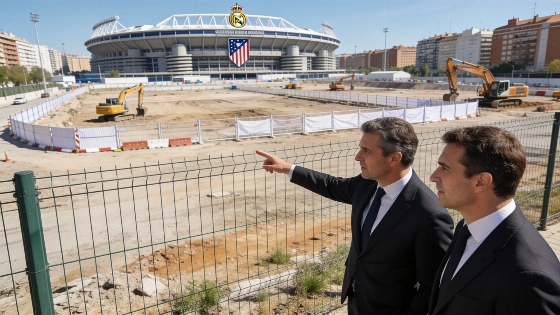
Atlético de Madrid is also benefiting from public land deals. Through Barsento S.L.U.—a joint venture with Live Nation—the club has secured a 75-year concession to use 205,000 square meters of municipal land around the Metropolitano stadium. The plan includes sports facilities, a large artificial wave pool, hotels, and commercial spaces, all run by private companies that set their own prices. The city council justifies the deal by pointing to new public sports infrastructure for the San Blas district, but critics say the terms heavily favor the club.
The Valdebebas project allows for the construction of hotels, offices, and hospitals on land previously designated for sports use. If all political and legal steps are completed, the development may not be finished until the late 2030s.
Giraldo notes that the roots of this arrangement go back years, with a sense of "debt" to Atlético after the city’s failed Olympic bid and the construction of La Peineta. The council’s special plan to allow mixed uses on the land was partially struck down by the courts in late 2025, limiting some of the club’s ambitions but leaving the main deal in place. Rita Maestre of Más Madrid accuses the mayor of putting private profit ahead of public service, while the Green Party objects to the long-term privatization of land that could have been used for much-needed local sports facilities.
Under the concession terms, Atlético will pay a staggered annual fee to the city—starting at €309,000 after five years, rising to €1.5 million in the final decades of the 75-year term. Opposition councillors argue these amounts are small compared to the profits the club could make. The city council says the high investment required justifies the long concession, but the result is that public land is tied up for generations.
Atlético de Madrid has not released full details of its planned developments. Public documents show plans for six football pitches, a mini-stadium for 6,000 spectators, 25 padel courts, a climbing wall, and commercial and hotel facilities. The old Centro Acuático, left unfinished after the Olympic bid, is also set for redevelopment into a multi-use arena, university campus, and sports complex, further blurring the line between public service and private business.
The city council highlights two parcels—totaling 60,000 square meters—where Atlético is building sports infrastructure to be managed by the San Blas district. These facilities, including athletics tracks and football fields, are expected to open by the end of 2026. The club is also responsible for connecting the area to the M-40 ring road and developing internal roads, which the council says justified offering the concession at zero upfront cost.
Deals like these are not unique to Madrid. Across Spain, the overlap of football, politics, and urban development has often led to controversy, as seen in the Chamberí penthouse sale. The pattern is familiar: when public land meets private ambition, ordinary residents rarely benefit.
These deals show a city government willing to make exceptions for its most powerful sports clubs, locking up public assets for decades in exchange for promises of economic growth and new jobs. In practice, the financial gains for Real Madrid and Atlético far outweigh the public benefits, while city residents are left with long-term commitments that limit future choices. This is less about public interest and more about transferring value from the public to the private sector, wrapped in the language of innovation and progress. When football clubs and city hall negotiate, the public rarely comes out ahead.