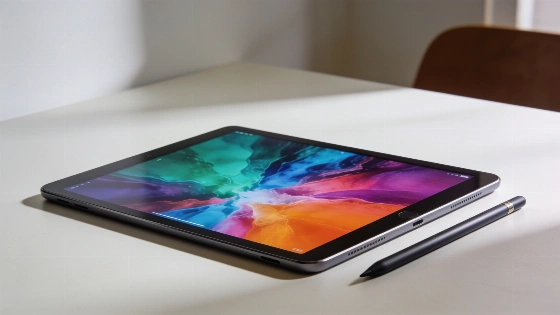
Samsung announced the Galaxy Tab S12 series on September 30, 2026, pitching the Galaxy Tab S12 Ultra and Galaxy Tab S12+ as work tools as well as large entertainment screens. Both support physical keyboard cases, sold separately, and adopt several familiar laptop features.
The prices and sizes make the target audience clear: these are premium devices for people who mix leisure with professional work. Samsung's pitch centres on productivity and creativity, with Galaxy AI, rather than casual media use.
The Ultra takes that approach furthest. Its 14.6-inch Dynamic AMOLED 2X display sits in a tablet just 5.1 millimetres thick. The device is also too large for comfortable use without support over several hours, though its size works well for films and games. The S12+ has a more manageable 12.6-inch panel with a 120 Hz refresh rate.
The basic change is in the software. Samsung has left the design largely unchanged from the previous generation.
Users can save up to three Multi Window desktop setups, so they don't have to rebuild their preferred app layout each time. One setup can handle work and another entertainment; apps can move between them when needed.
The included S Pen supports handwritten notes and photo editing. It is more than an extra accessory.
Google's Gemini works with Samsung's own apps and third-party tools including Notability and Goodnotes, as well as LumaFusion and Photoshop. Photoshop comes pre-installed on an Android device for the first time. Buyers also receive six months of free access to the Pro model.
That approach has a limit: Samsung keeps much of the experience inside its Galaxy environment. Apps with wider appeal could reach more people through Google Play, and the same applies to the Apple Store. The company's tightly controlled device strategy contrasts with the wider business focus described in an earlier franchise report. Samsung Poland's announcement also names Goodnotes and LumaFusion, along with Adobe Photoshop, in the creative software package.
Both tablets use the MediaTek Dimensity 9500. Samsung chose neither Qualcomm's Snapdragon, used in the Galaxy S26 Ultra, nor its own chips.
The manufacturer says the new processor improves the neural processing unit by 60% over the previous model. A redesigned vapour chamber should move heat away more effectively. Android Central and AndroidPure also identify the Dimensity 9500 as the platform in both tablets.
The screens need a lot of power. Samsung claims up to 23 hours of battery life for the Ultra and 21 hours for the Plus. If those figures hold in daily use, they would cover a full day of university note-taking.
A 45 W fast charger is said to take either tablet from zero to full in 95 minutes. Both models support 5G and Wi-Fi 7. Bluetooth 6.0 is also included, while each tablet has four speakers for films and games.
The cameras differ. The Ultra has a 13-megapixel basic sensor and an 8-megapixel ultra-wide camera; the Plus leaves out the ultra-wide unit.
Both models have IP68 protection against water and dust. They also accept microSD cards of up to 2TB.
Sales in Spain begin on October 7. The Galaxy Tab S12 Ultra starts at €1,539 with 12GB of RAM and 256GB or 512GB of internal storage. A version with 16GB of RAM and 1TB of storage is also available.
The Galaxy Tab S12+ starts at €1,299 with 12GB of RAM and 256GB or 512GB of storage. Both tablets come only in metallic grey.
Prices vary by market and configuration. Samsung Germany lists the S12+ at approximately €1,499 for Wi-Fi and €1,649 for 5G in a 512GB configuration. US coverage puts starting prices at about $1,199 for the S12+ and $1,399 to $1,400 for the Ultra.
These prices put both tablets well above the casual-use market.
Samsung wants buyers to compare them with laptops while keeping Android at the centre. The package suits users who want a very large display and an included pen. It also offers desktop-style multitasking, with expandable storage.
The Ultra's size matters, as does the separate keyboard cost. The S12 range is not designed to replace every laptop; it offers users who can pay for the top version a more credible professional workstation on Android.
Flagship Android tablets are moving in the same direction: prices are rising, and laptop-style workflows are taking priority over mass-market entertainment.